
Rural Water Supply: Dry Hydrants, Cisterns and What the Fire Department Needs
Past the end of the water main, the fire at your house is fought with whatever arrives on the truck plus whatever your property can supply. Here's how that actually works.
The problem, stated plainly
A pumper arrives carrying somewhere between 2,000 and 4,000 litres. At a working structure fire that is minutes, not hours. After that, water has to come from somewhere — a shuttle of tankers running to the nearest fill point, or a static source close enough to draft from.
If you live past the hydrants, that arithmetic is your fire protection, and it is largely fixed before anything happens. A pond with a proper connection and a road a loaded truck can use is worth more on the day than almost anything you could buy and put on the house.
It is also one of very few things in home fire safety that helps your neighbours as much as you, and one of the few that shows up in how your area is graded for insurance.
What a dry hydrant is
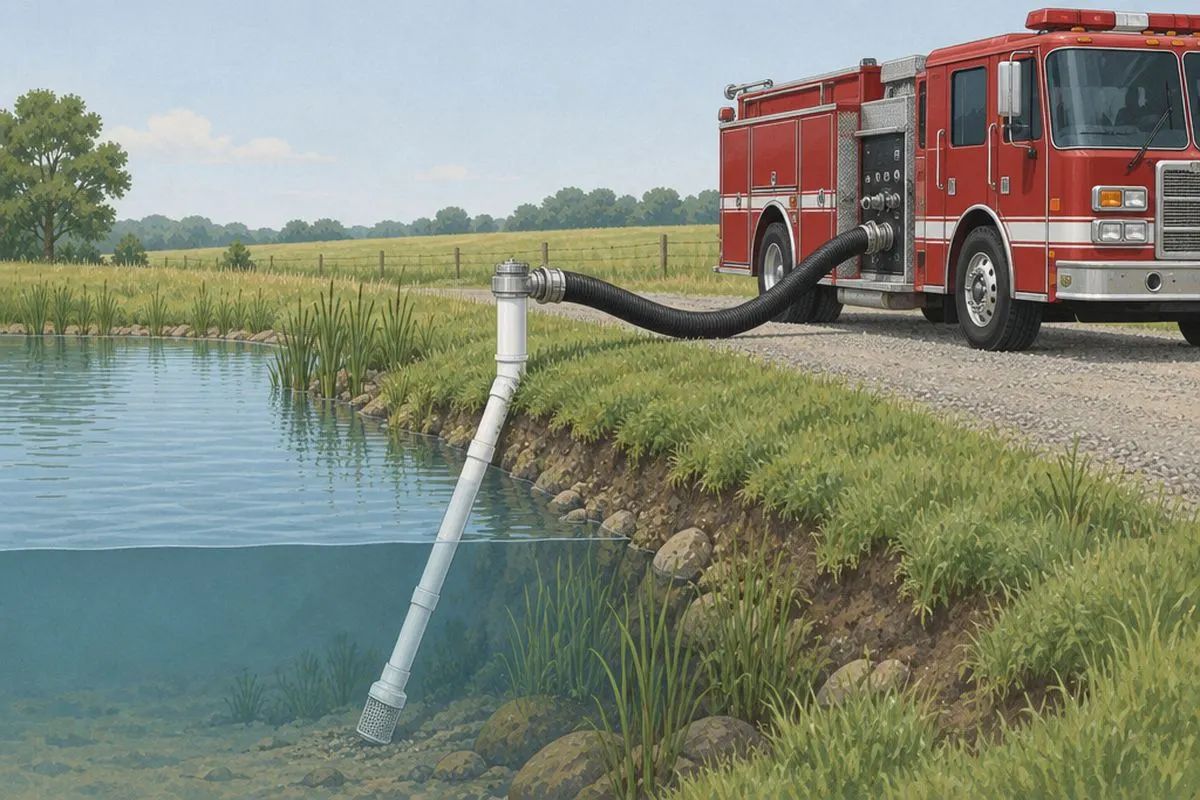
A pipe. That is genuinely most of it. A strainer sits submerged in a pond, stream or buried cistern; schedule 40 pipe, usually six inch, runs from it below frost depth out to a standpipe at the roadside; the standpipe ends in a fire-thread connection with a cap. There is no water in it at rest — hence dry.
When a pumper connects and evacuates the air, atmospheric pressure pushes water up the pipe. Nothing moves, nothing is powered, and nothing freezes if it was built right.
The reason it matters is speed and certainty. A crew that knows there is a tested connection at a known location with a known flow can plan around it. A crew improvising down a muddy bank in the dark cannot.
Physics sets the limits, not budget
The binding constraint is lift — the vertical distance from the water surface up to the pump. At sea level the theoretical maximum is about 34 ft; a real fire engine achieves roughly two thirds of that, about 22.5 ft, and you lose about a foot for every 1,000 ft of elevation.
Design practice is far more conservative. NFPA 1142's annex advises keeping lift as low as possible and not exceeding 10 to 12 ft, and says something worth quoting to anyone who suggests a bigger pipe will fix a bad site: this loss cannot be overcome by enlarging the pipe size.
The second constraint is submergence. You want at least 2 ft of water above the strainer and 1 ft below it, measured against the 50-year drought level rather than against how the pond looks in June. Less than that and the pump pulls a vortex, entrains air and loses prime.
The third is volume, and here the trap is the word pumpable. Usable water runs from the lowest foreseeable water level down to the top of the strainer — not to the bottom of the pond. The NRCS threshold for a fire-suppression dry hydrant is 30,000 gallons pumpable, or 250 gpm sustained for two hours. A quarter-acre pond that drops three feet by August may have almost nothing usable in the month the risk is highest.
How much water a house actually needs
NFPA 1142 gives a calculation: the structure's total cubic volume, multiplied by a construction classification number, divided by an occupancy hazard number. Wood frame construction carries the worst multiplier at 1.5; dwellings sit in the least demanding hazard class at 7.
For a 2,500 sq ft house with nine-foot ceilings — about 22,500 cubic feet — that comes to roughly 4,800 gallons before adjustments. Multiply by 1.5 if there is another structure over 100 sq ft within 50 ft of it, which on most rural properties there is.
Authorities having jurisdiction turn this into tables. El Dorado County in California, for instance, runs from 2,500 gallons for a small sprinklered structure to 40,000 gallons for a large unsprinklered one, with tanks required at least 30 ft from any structure. Notice that sprinklers roughly halve the stored water requirement — one of the few places the two systems interact.
Your fire department will do this calculation for you, and their answer is the one that counts. Ask them before you size anything.
Access is half the installation
NFPA 1142's access requirements read like common sense until you measure your own driveway. The hydrant has to be sited so a pumper connects with no more than 20 ft of hard suction hose. It has to sit at least 100 ft from any structure. Three feet of clear space around it, nothing parked or stored within 20 ft of the access side, and accessible in all weather.
Design for a loaded pumper — thirty tons or more — not for a pickup. That means an all-weather surface, adequate width, and somewhere to turn around. On a great many rural properties the road work costs more than the hydrant.
And it has to be findable at 3 a.m. in smoke. Reflective marking and signage approved by your department, checked annually. One thoughtful note from the NRCS standard: if the source turns out to be marginal, sign it as inadequate. A mismarked source that fails when a crew is depending on it is worse than no source at all.
What it does for your insurance
This is the part most homeowners do not know, and it is the strongest financial argument in the category.
In Canada, the Fire Underwriters Survey grades dwellings 1 to 5. Grades 3B and 4 do not require a municipal water system — they require a department with the equipment, training and access to approved alternative water supplies to run a tanker shuttle in accordance with NFPA 1142. FUS treats dry hydrants with suction points as equivalent to standard hydrants, and says properties within 300 metres may qualify for better dwelling grades. Above that sits Superior Tanker Shuttle Service accreditation, which FUS describes as a recognised equivalency to hydrant protection and which brings rates similar to a hydranted community.
In the US, ISO's Public Protection Classification credits alternative water supplies that can deliver 250 gpm for two hours, year-round, within five minutes of the first apparatus arriving. A creditable suction point is treated like a hydrant: properties within 1,000 ft of one can be graded better than Class 9.
The important nuance in both countries is that the grading is of the community and the department, not your parcel. So the highest-leverage move for a rural owner is often not a private tank at all — it is helping the local department get accredited, and an accessible dry hydrant on your land is frequently part of what gets them there.
What this costs, and who pays
Hard current numbers are scarce. The most citable figure is a USDA-NRCS cost scenario putting a straightforward 200 ft, six inch PVC installation at about USD $3,000 — but that is 2014 money and assumes cooperative site conditions. Grant caps give a rough sense of scale: Connecticut reimburses half the cost up to $2,000 for a standard install and $3,000 for a cistern system.
Realistically: low four figures for a simple pond install where the machinery can get in, considerably more once you add excavation, long pipe runs, or road and turnaround work. We could not verify a current typical installed cost and would not invent one.
On funding, note a structural point that catches landowners out. In the US, the grant programmes — Virginia's, Connecticut's, and state forestry programmes generally — fund fire departments and municipalities, not private owners. Your role is usually granting access or an easement while the department applies. The exception is NRCS conservation practice cost-sharing, which is the main landowner-facing federal route. We found no Canadian equivalent to those state forestry grants at all; ask your regional district or fire protection district directly.
The portable alternative
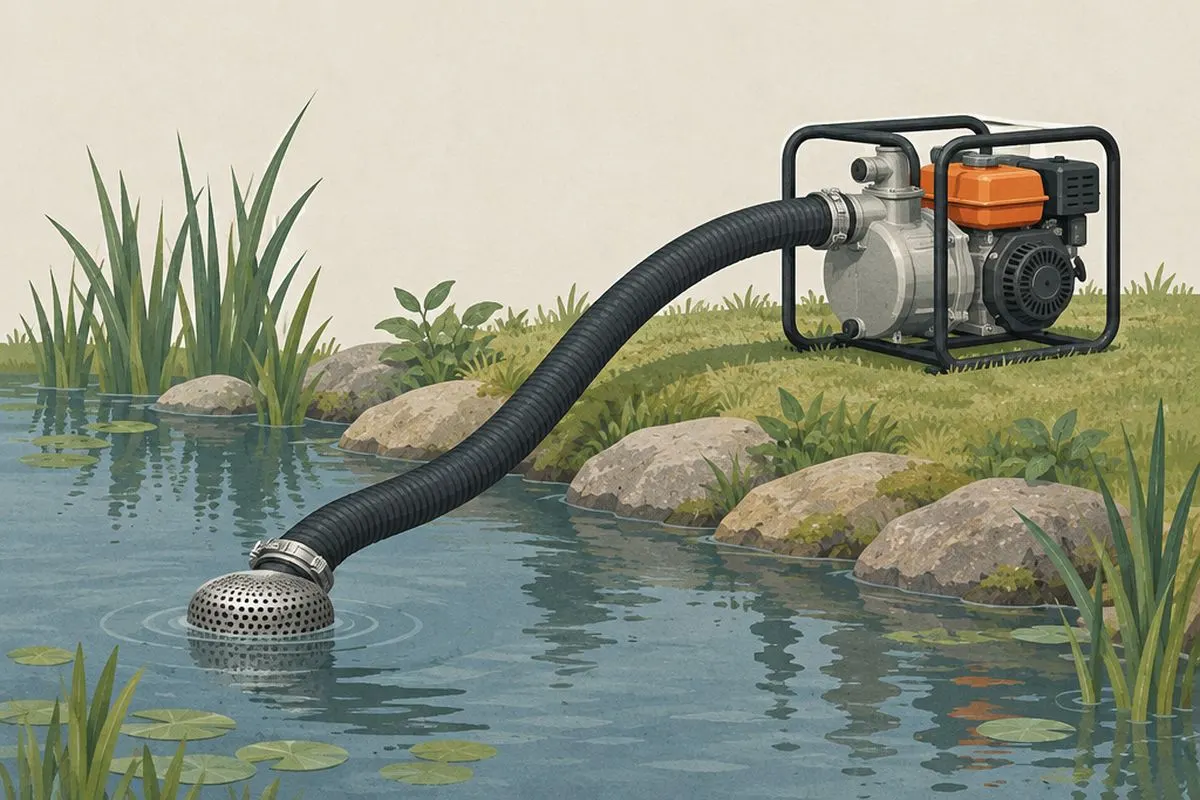
If a fixed installation is out of reach, hard suction hose and a low-level strainer let a pump draft from an accessible source without any civil works. It costs a fraction as much and goes wherever you carry it.
The trade is that it needs a person on the bank at the time. A dry hydrant works for a crew that arrives when you have already evacuated — which, if you have been reading the rest of this site, is what you should be doing.
Whatever you buy, the lift rule still applies and the thread still has to match. Ask your department what hard suction and what thread they carry before you order anything, and buy the adapters in the same order as the hose.
 Illustration
Hard Suction Hose & Low-Level Strainer
Rigid, non-collapsing hose that lets a pump draw from an open water source, with a strainer that keeps debris out and prevents the vortex that loses your prime. The portable alternative to a fixed dry hydrant.
 Illustration
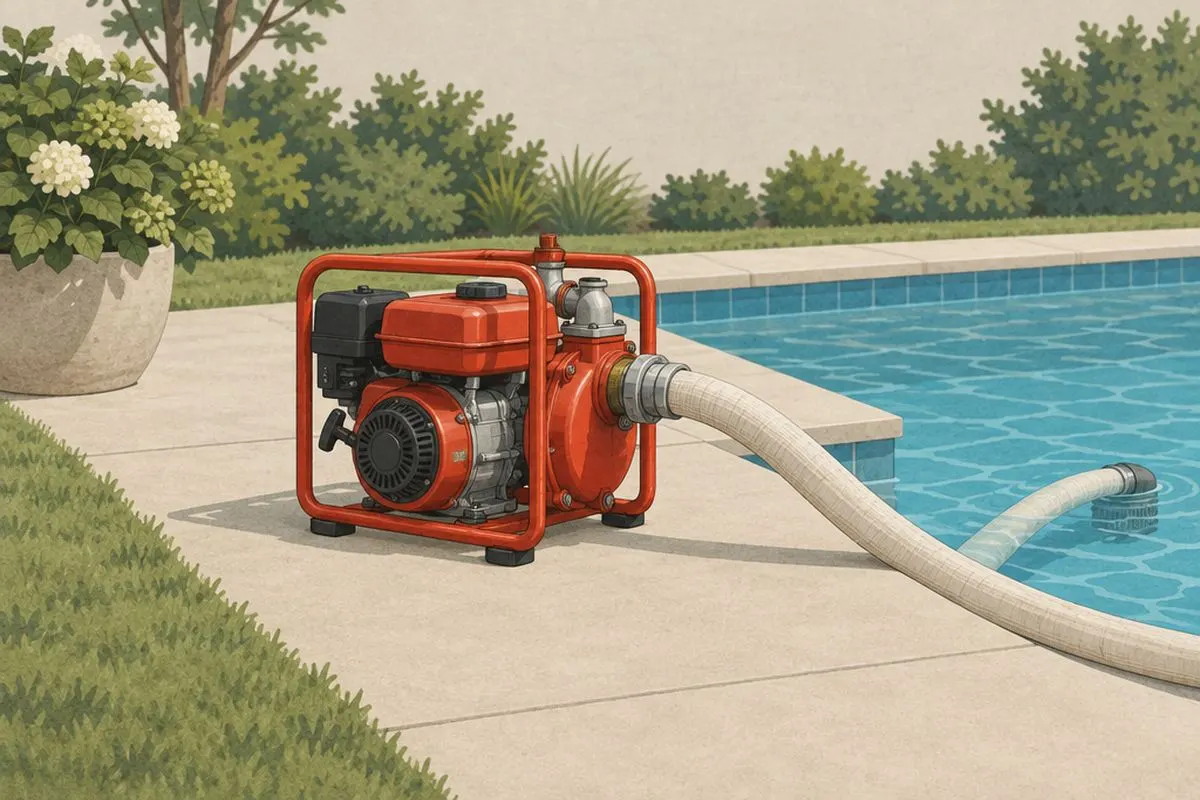
Portable Gas Fire Pump (1.5 in)
A high-pressure 1.5 in gas pump moves water from a pool, pond or tank at enough pressure to run a roof sprinkler kit plus a hose line. The Honda-engine models are the reliability benchmark; buy the high-pressure variant, not the trash-pump variant.
One thing that is not a fire water supply
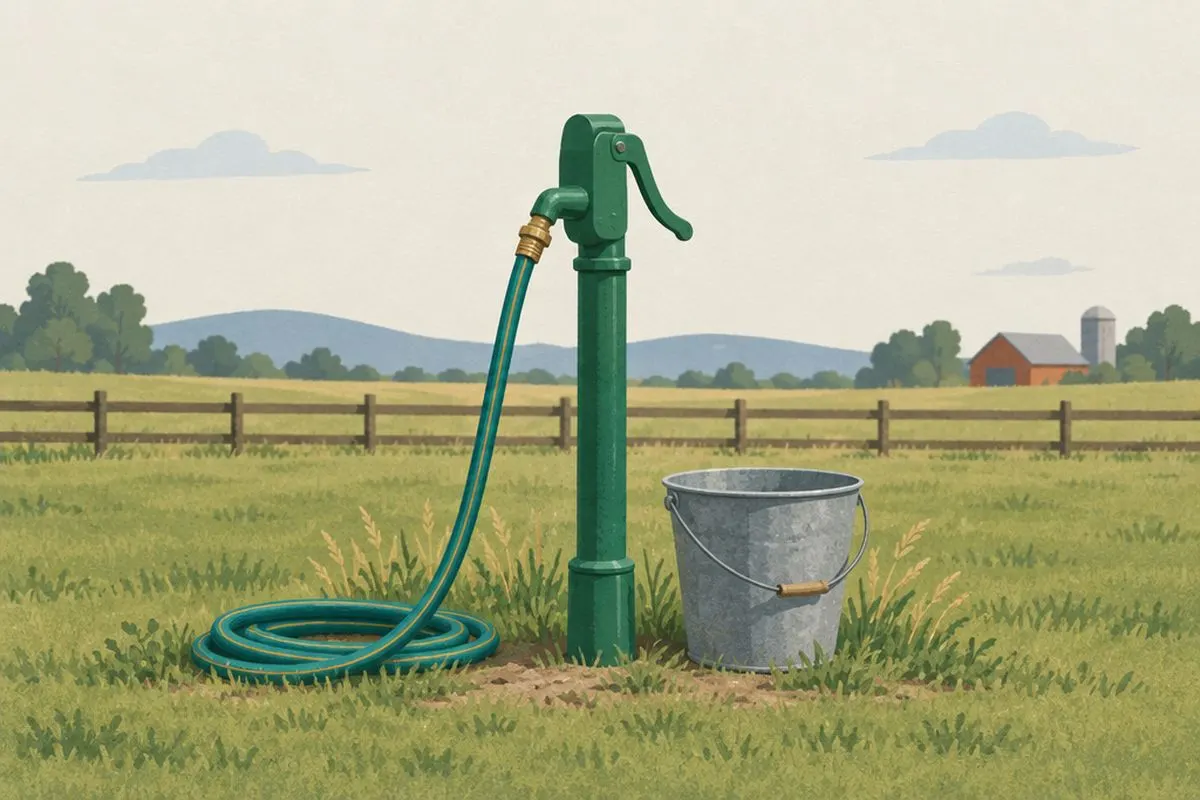
A frost-free yard hydrant is a genuinely useful thing to own and it is not firefighting infrastructure. The numbers are not close. A standard one delivers 5 to 9 gpm, and a commercial unit with a one-inch inlet perhaps 15 to 20.
For comparison: NFPA 1142 asks a dry hydrant to deliver 1,000 gpm at draft. The ISO threshold for a creditable alternative supply is 250 gpm for two hours. Even a residential sprinkler system's entire design demand is up to about 40 gpm.
So a yard hydrant is about one to two percent of a creditable fire flow. Use it for what it is good at — filling a backpack pump, wetting a fence line, soaking a spot fire after ember fall, topping up a portable tank — and never mark it in any way that suggests a crew could use it.
 Illustration
Frost-Free Yard Hydrant
A standpipe with its valve below the frost line that drains after each use, giving year-round outdoor water well away from the house. Genuinely handy. Not, despite the name, firefighting infrastructure.
 Illustration
5-Gallon Backpack Fire Pump (Indian / Smith-style)
The refillable water backpack every wildland crew carries. Knocks down spot fires on mulch, decks and grass with a directed stream. Fill it from any bucket or tank.
Sources
NFPA 1142, Standard on Water Supplies for Suburban and Rural Firefighting, Chapter 8 and annex. USDA-NRCS Conservation Practice Standard 432 (Dry Hydrant) and its cost scenarios. NWCG firefighter math on drafting guidelines. El Dorado County Standard D-003 and Grayson County, Texas guidance on the NFPA 1142 calculation.
Fire Underwriters Survey on Dwelling Protection Grade and Superior Tanker Shuttle Service accreditation. Verisk/ISO Mitigation on alternative water supplies. Virginia Department of Forestry and Connecticut DEEP dry hydrant grant programmes. Boshart technical data on yard hydrant flow rates.
Current as of September 2026. Design requirements are set by your authority having jurisdiction and override anything here.