
How to Build a House That Survives Wildfire
What the codes require, what the best voluntary standard adds, and what the extra actually costs — which, if you are already building to code, is about two thousand dollars.
The number that should start this conversation
In October 2025, Headwaters Economics and IBHS priced four versions of the same 1,750 square foot house in Altadena against a $500,000 baseline: built traditionally, built to California's WUI code, built to the IBHS Wildfire Prepared Home standard, and built to the highest tier.
Building to the highest voluntary standard rather than traditionally cost about $15,000 more — roughly 3% of the cost of the wildfire-critical components, or about $50 a month on a thirty-year mortgage.
Building to the highest voluntary standard rather than to California's WUI code cost about $2,000 more. Two thousand dollars, for enclosed eaves and dual-pane tempered windows.
If you are building new in fire country, the marginal cost of doing it properly is close to a rounding error. The expensive path is retrofitting the same features onto a house that was built without them.
What California requires — and what it is now called
For thirty years the reference point has been 'Chapter 7A' of the California Building Code. As of 1 January 2026 that chapter no longer exists. Its contents were moved into a new standalone code, the California Wildland-Urban Interface Code, Title 24 Part 7, based on the 2024 International WUI Code. Almost every consumer article still says Chapter 7A. Your local building department may too, and several local editions still publish one.
The substance carried across. In a Fire Hazard Severity Zone, new construction requires: a Class A roof assembly, with valley flashing of at least 26-gauge corrosion-resistant metal over a 36-inch-wide cap sheet; exterior wall materials that are non-combustible, ignition-resistant, heavy timber or log, running from foundation to roofline; two-inch solid blocking at overhangs; ember-resistant vents; multi-pane glazing with at least one tempered pane, or glass block, or a 20-minute fire rating; exterior doors that are non-combustible, ignition-resistant, solid core at least one and three-eighths inches, or 20-minute rated; and decks within ten feet of the structure built of ignition-resistant, heavy timber or fire-retardant-treated wood.
A 2025 rulemaking extended application to High Fire Hazard Severity Zones in Local Responsibility Areas and refined the accessory-structure provisions based on NIST and IBHS research into fences and outbuildings.
Section numbers changed with the move. If your drawings cite Chapter 7A sections, they need updating.
Vents: the requirement that quietly got much stricter
Until 2021, California let you comply on vents with non-combustible one-eighth-inch mesh. It does not any more. Since 1 July 2021, ventilation openings must be covered by vents either approved by the State Fire Marshal or listed to ASTM E2886, and traditional mesh or louvered vents cannot pass that test.
The standard has three parts and they are demanding: no flaming ignition of the cotton material during the ember intrusion test; no flaming ignition during the integrity portion of the flame intrusion test; and the unexposed side must not exceed 350°C.
It applies to gable ends, ridge ends, crawl spaces, foundations and all vertical-wall vents. Eave and cornice vents are prohibited on the underside unless they meet the same three criteria.
To verify a product, check that it appears in CAL FIRE's Building Materials Listing database, that the listing explicitly states it is rated to ASTM E2886, and that it is approved for the orientation you are installing it in — horizontal and vertical listings are not interchangeable.
Worth noting the standards do not agree with each other here. IBHS's Essential tier still accepts one-eighth-inch non-combustible mesh as an alternative, and FireSmart Canada accepts 3 millimetre screening, which is roughly the same thing. In California, the code wins.
 Illustration
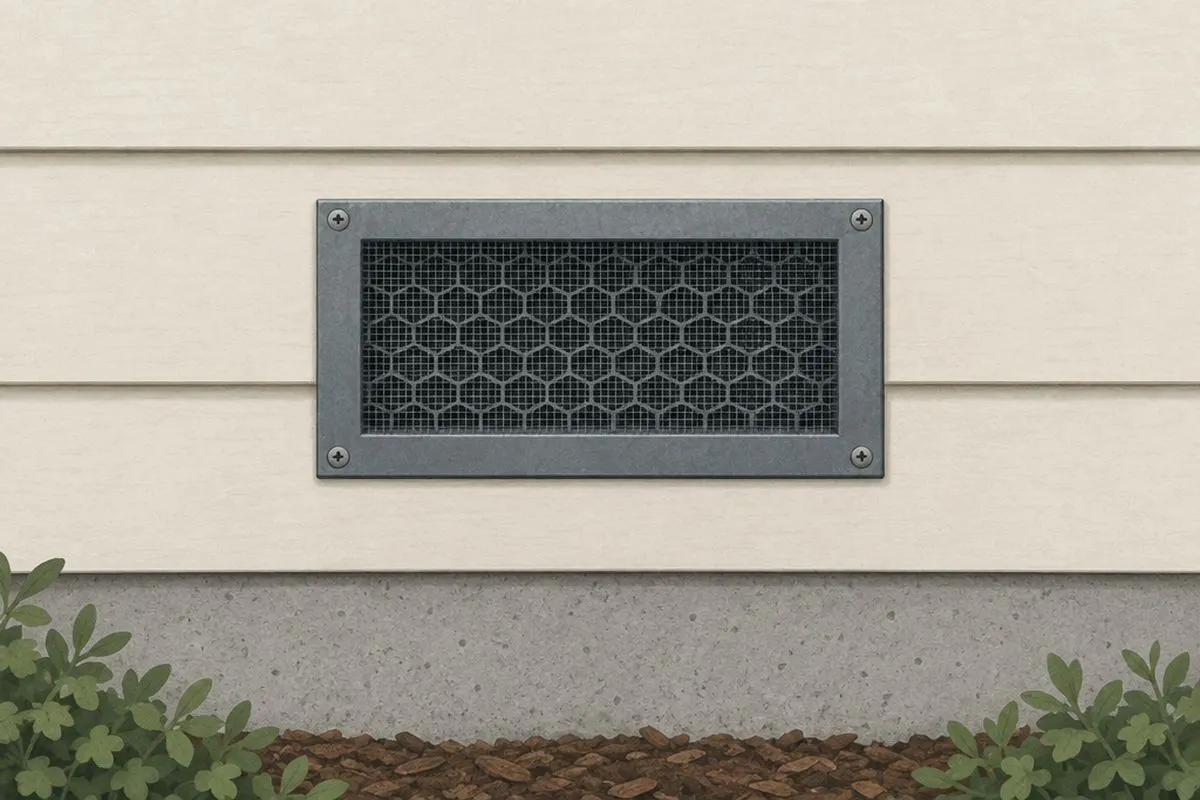
Vulcan Ember-Resistant Vents
WUI-listed vents with an intumescent honeycomb that expands and seals at roughly 350°F, plus 1/8 in mesh. Available in soffit, gable, foundation and dormer formats in standard sizes.
 Illustration
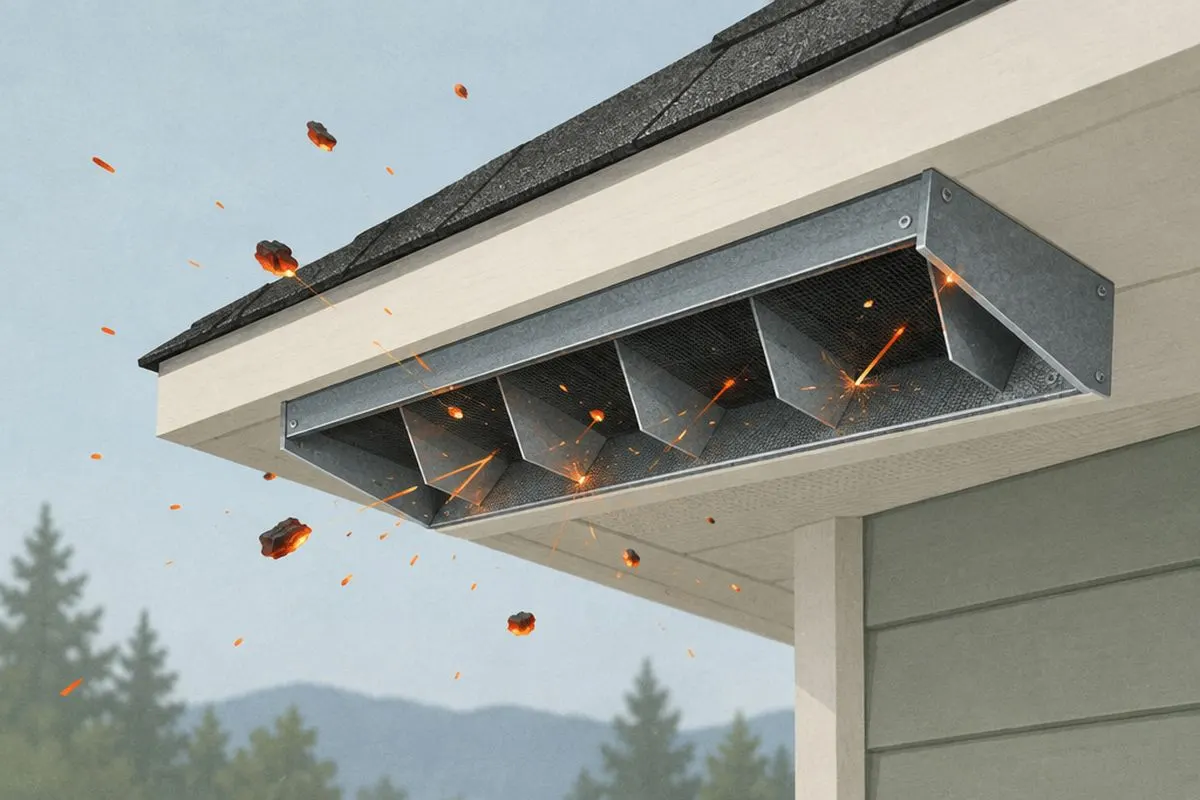
Brandguard Ember & Flame Vents
Uses a patented baffle design to stop embers without relying on fine mesh that clogs. Good airflow numbers and a wide catalogue of eave, gable and foundation models.
Windows, and the best new evidence in the field
A 2025 study in Fire Technology tested forty window assemblies of each type under exterior fire exposure, and the result is unusually clear-cut. With plain annealed glass on the back pane, 37 of 40 assemblies failed completely. With a tempered back pane, only 12 of 40 failed. Tempered assemblies withstood roughly double the heat load before complete failure.
Two details matter for anyone specifying windows. The fire-side pane always fails first, in every configuration — so the protective value sits in the back pane. And the best-performing configuration was plain glass on the fire side with tempered behind it, which performed as well as dual-tempered. That is useful because it is cheaper.
The study also found something that changes how you think about the risk: heat flux on the back side exceeded the ignition threshold for household materials before the window failed at all. Curtains and furniture can ignite through an intact window. A house does not need a broken window to burn from the inside.
Frames are a separate failure path that codes address less well. Unreinforced vinyl frames deform under radiant heat and let embers through gaps without any glass breaking. Aluminium cross-piece reinforcement prevents it.
In the Camp Fire, 63% of damaged homes showed radiant heat damage, primarily to windows and siding. Among structural features analysed across five years of Californian fires, window panes ranked second in explanatory power for whether a home was lost.
The roof question, and a statistic that misleads
A Class A roof is the baseline in every code and both IBHS tiers, tested to ASTM E108 or UL 790. There are two routes to it. Some coverings are rated stand-alone — flat and barrel clay tiles, fibreglass asphalt composition shingles, metal. Others are rated only by assembly, needing a specific underlayment beneath, which includes fire-retardant-treated wood shakes and some aluminium coverings. A 'Class A metal roof' over the wrong underlayment is not a Class A assembly, and this trips up renovations constantly.
Roofs fail at their edges and intersections rather than in the field. Valleys, roof-to-wall junctions at dormers, and the gap between covering and sheathing are where embers get in, which is why the code is so specific about flashing.
Now the statistic that misleads. In an analysis of Californian fires between 2013 and 2018, roof type ranked last among the structural features tested for explanatory power — behind eaves, window panes, vent screens, siding and deck material. Read carelessly, that says roofs do not matter.
It almost certainly says the opposite. Class A roofs have been mandatory in California since 2008, so by the time of those fires nearly every house had one and there was very little variation left to explain. Roof class is table stakes. The differentiators have moved elsewhere, which is precisely why eaves and windows now top that list.
Decks, fences and the things you bolt on afterwards
IBHS ember testing on eight decking products found that the material matters less than what happens underneath. Embers fall through the gaps between boards and ignite debris below. Most plastic composites smouldered without flaming; only a medium-density softwood and one polyethylene composite sustained flame.
Their recommendations are counterintuitive and worth following: joists at 24 inches on centre, wider board gaps rather than narrower — a quarter inch instead of an eighth — so embers fall through rather than lodging, protective coatings on joists, and a non-combustible zone beneath any attached deck.
On fences, NIST ran 187 experiments and produced the clearest single design rule in wildfire construction: never build back-to-back combustible fences on a property line. Two panels together engulfed 8-foot sections in under four minutes, the most intense fires in the study. Even fences separated by three feet still produced dangerous flames. Mulch at the base of a fence let flame run its full length rapidly.
If a combustible fence meets your house, replace the last section with steel. It is a few hundred dollars and it breaks the most direct fuel path most suburban properties have.
Canada has no equivalent, and that is worth knowing
There is no Canadian Chapter 7A. The National Building Code of Canada 2025, published in December 2025, does not list wildland-urban interface construction among its changes — the published summary covers accessibility, radon, climate data, emissions and energy retrofits.
What Canada has is guidance. The National Research Council published the National Guide for Wildland-Urban Interface Fires in 2021, the first of its kind in the country, covering hazard assessment, vegetation management, construction approaches and community planning. It is advisory, not mandatory.
Something more code-like is coming. CAN/UL 2530, a Standard for Wildland-Urban Interface Fire Risk Mitigation in the Structure Ignition Zone, is in development as a National Standard of Canada, with scope covering construction guidance and alignment with the National Building Codes. Its publication timeline is not public.
FireSmart's construction guidance is the practical Canadian reference in the meantime: Class A fire-rated roof assembly — clay or concrete tile, metal, asphalt shingles; stucco, brick, fibre cement or poured concrete siding, with an explicit warning against vinyl, which melts; non-combustible material on all vents, specified as 3 millimetre screening or ASTM-rated vents; non-combustible gutters in galvanised steel, copper or aluminium with a metal drip edge; and non-combustible or fire-rated decking.
Whether provinces should make any of this mandatory is an active debate in BC and Alberta and has been for several fire seasons. As of now, they have not.
If you are rebuilding after a loss
Rebuilding is the one moment when all of this is cheap, and it is also the moment when people are least equipped to think about it — exhausted, fighting an insurer, and being pushed to get back in before another winter.
Two things are worth holding on to. First, the $2,000 figure: if your rebuild is already meeting a WUI code, reaching the highest voluntary standard is a marginal cost, and you will never get this chance again at this price. Second, that code upgrade costs are usually an insured cost — in California explicitly so, and payable regardless of where you rebuild.
And ask whether to rebuild in the same footprint. The single strongest predictor of survival in the Camp Fire analysis was distance to the nearest structure. If the lot allows any meaningful increase in separation, that is worth more than most of the material upgrades on this page combined.
Sources
California Building Standards Commission on the relocation of Chapter 7A into the California Wildland-Urban Interface Code, Title 24 Part 7, effective 1 January 2026, and the 2025 intervening-cycle rulemaking. CALBO guidance. CAL FIRE Building Materials Listing and the July 2021 ASTM E2886 vent change.
Headwaters Economics and IBHS, Altadena new-construction cost study, October 2025; Headwaters Economics California cost study, July 2022. Willi, Gorham and Horn, 'Window Pane Failure During Exterior Fire Exposure', Fire Technology 61(4), 2025. Syphard and Keeley, Fire 2(3):49, 2019. Knapp et al., Fire Ecology 17:25, 2021. Quarles and Standohar-Alfano, IBHS deck ember testing. NIST fence and mulch study, August 2022. UC ANR Fire Network on roofs and windows.
National Research Council Canada, National Guide for Wildland-Urban Interface Fires (2021) and National Building Code of Canada 2025. Standards Council of Canada notice for CAN/UL 2530. FireSmart Canada construction guidance. Current as of September 2026.