
Is There Such a Thing as a Fireproof House?
No — and the people who study this for a living are blunt about it. What exists instead is an ignition-resistant house, which is a lower bar and a far more useful one.
The word the researchers refuse to use
Jack Cohen, who did the foundational US Forest Service research on how houses ignite, puts it in one line: ignition-resistant structures do not mean a fireproof structure.
That is not false modesty. Concrete spalls. Steel conducts and deforms. Glass breaks. Given enough time under enough heat, any building fails. The question is never whether a house can withstand unlimited fire; it is whether it can get through the roughly one to two hours when embers are falling and a neighbour may be burning, without anything catching.
So the industry term is ignition resistant, and the goal is to eliminate the ignition opportunities rather than to armour against flame. That reframe is the whole discipline. It is also why the effective measures are so much smaller and cheaper than people expect.
What an ignition-resistant house actually has
The Insurance Institute for Business & Home Safety runs the most rigorous voluntary standard in North America, Wildfire Prepared Home. In June 2026 it renamed its two tiers: what was Base is now Essential, and what was Plus is now Enhanced. If you see 'Wildfire Prepared Home Plus' written anywhere, including on this site's older pages, it is the superseded name.
Essential is the ember package. A Class A roof with no wood shakes. Vents that are either tested to ASTM E2886 or covered in non-combustible mesh of one-eighth inch or finer. Non-combustible gutters, kept clear. The first five feet cleared to bare mineral soil with no combustible fence or stored items. Decks clear of debris, with six inches of clearance at posts. The bottom six inches of wall non-combustible.
Enhanced adds protection against radiant heat and direct flame, which is where the money is. Enclosed eaves. Covered non-combustible gutters. Multi-pane tempered windows, or 20-minute rated glazing, or glass block. All exterior wall covering non-combustible. A solid non-combustible deck surface with non-combustible railings within five feet. No back-to-back combustible fences between five and thirty feet.
That is a complete, checkable specification, and it is worth noticing what is not on it: no sprinkler system, no gel, no wrap. Those are useful, and we cover them elsewhere on this site, but they are not what the standard considers a hardened house.
 Illustration
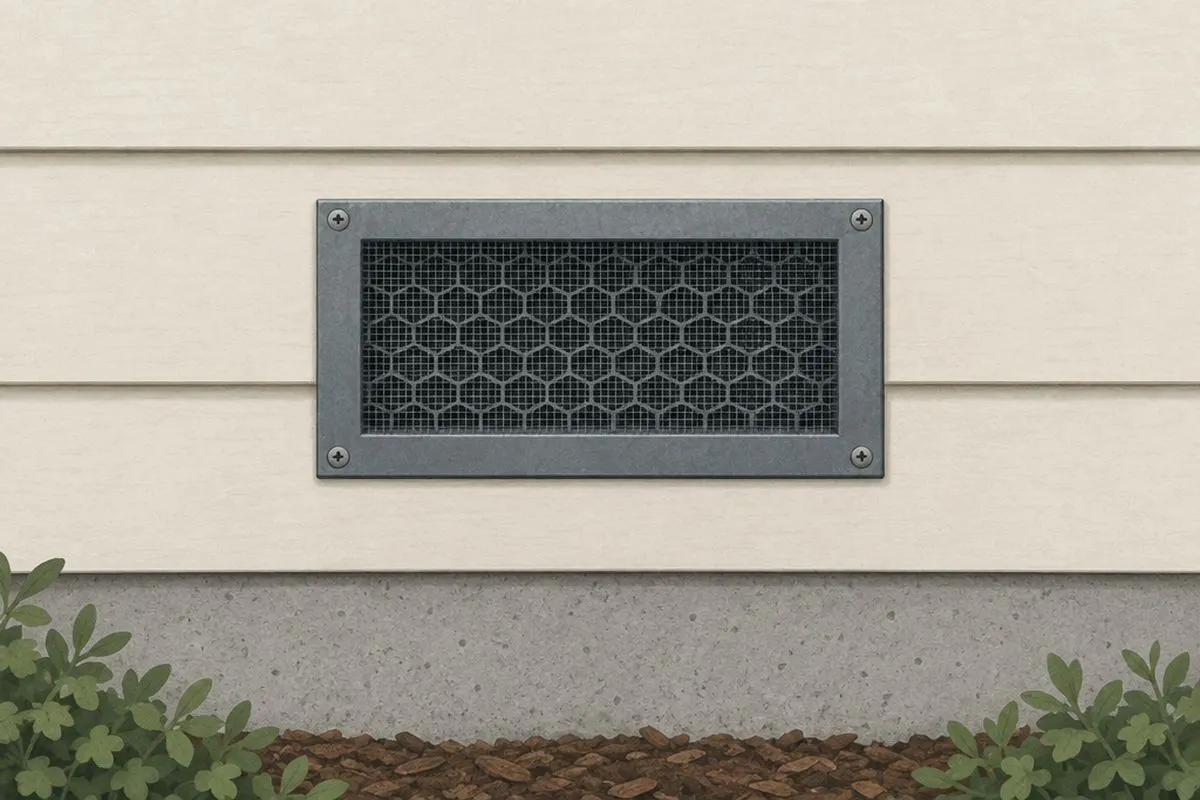
Vulcan Ember-Resistant Vents
WUI-listed vents with an intumescent honeycomb that expands and seals at roughly 350°F, plus 1/8 in mesh. Available in soffit, gable, foundation and dormer formats in standard sizes.
 Illustration
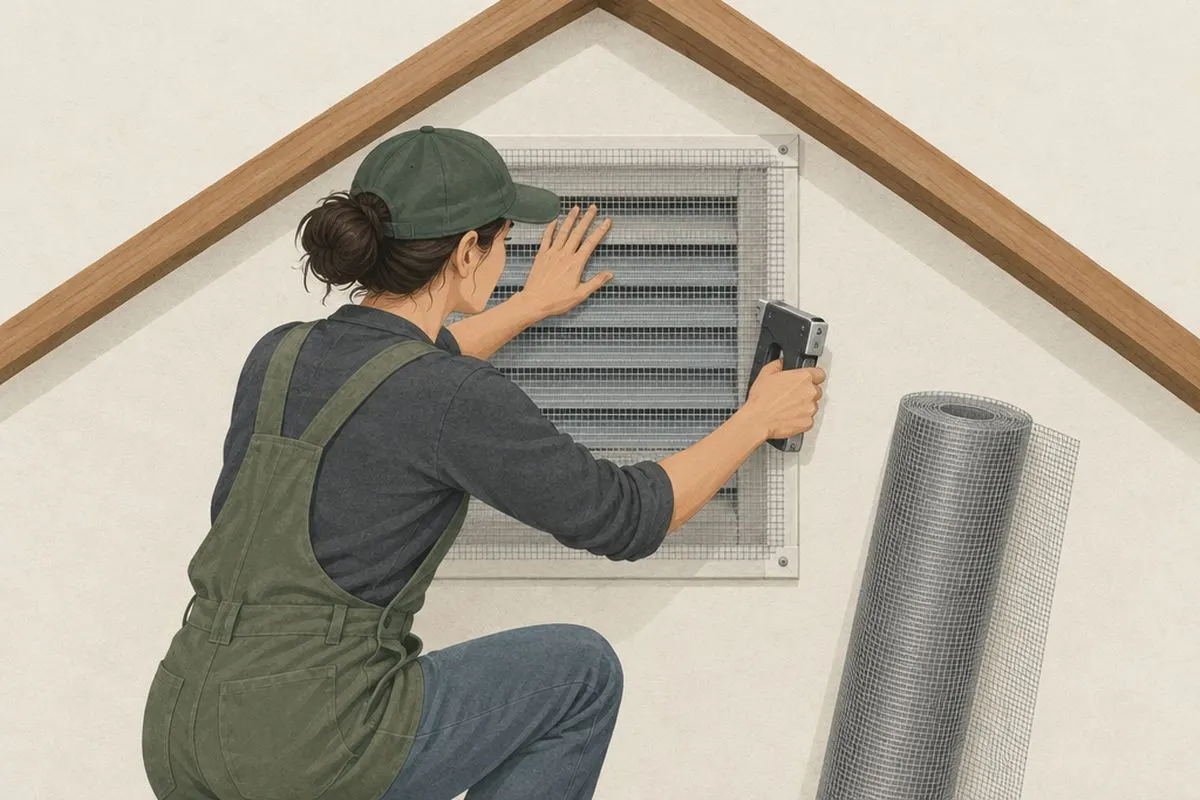
1/8 in Stainless Steel Ember Mesh
A roll of 1/8 in (3 mm) stainless mesh stapled or screwed over existing vents is the recommended retrofit when replacement isn't practical. Also use it to close gaps under decks and at the base of siding.
Does it work? Yes, partially, and the number is sobering
IBHS assessed more than 250 properties in the Palisades and Eaton fires and cross-referenced CAL FIRE records on over 30,000 structures. Homes with four hardening features — Class A roof, non-combustible siding, double-pane windows, enclosed eaves — had a 54% likelihood of avoiding damage. Homes where only one measure had been taken: 36%.
That is a real and meaningful improvement. It is also, read plainly, a coin flip. In an extreme wind-driven conflagration, doing nearly everything right still left about half of those homes damaged.
The Camp Fire gives a similar shape from a different angle. Homes built before 1997 survived at 11.5%. Those built between 1997 and 2007, 37%. Those built from 2008, after California's WUI construction standards came in, 44%. Tempting to call that proof that the code works — but the study's authors were careful, and so should we be: the difference between the newest two groups was not statistically significant, and newer homes also sat on different lots with different spacing. The code almost certainly helps. That study cannot prove by how much.
The thing hardening cannot fix
In that same Camp Fire analysis, the strongest predictor of survival was not the roof or the vents. It was distance from the nearest destroyed building — 5.8% survival within 18 metres, 35.4% beyond it. IBHS found spacing under 10 feet posed significant risk and over 50 feet very little.
If your house sits 6 metres from your neighbour's, you have a category of exposure that no amount of personal spending resolves, because a burning house next door produces radiant heat far beyond anything the forest generates. The Camp Fire researchers were explicit that defensible space improvements alone proved insufficient against intense radiant heat from nearby burning structures.
This is the strongest practical argument for the neighbourhood programmes — Firewise USA in the States, FireSmart neighbourhood recognition in Canada, and IBHS's new Wildfire Prepared Neighborhood standard introduced in 2026. On a tight lot, a conversation with the three neighbours nearest you is worth more than another product.
Where the myth comes from
Two things keep the fireproof idea alive.
The first is that houses genuinely do survive when everything around them is gone, and the photographs are striking. Cohen has documented survivals in Paradise, in Lytton, and in Fort McMurray. But those houses were not fireproof; they were houses where nothing caught. Usually because the gutters were clean, the vents were screened, the first few feet held nothing that burns, and no neighbouring building was close enough to cook them.
The second is marketing. 'Fireproof' sells better than 'reduces the probability of ignition'. Be suspicious of any product sold on the first phrase. A fire blanket rated to 1,800°F is a real thing, but that rating describes a short exposure in a controlled test, not a house standing in a firestorm.
The honest framing is probabilistic and unsatisfying, and it is the one every serious researcher uses: you are shifting odds, not buying immunity.
What to do with that
Accepting that no house is fireproof changes the shopping list in a specific way. It moves you away from single expensive objects and toward eliminating ignition points, because a system with one hole in it fails at the hole.
Practically: work through the Wildfire Prepared Home Essential list, which is mostly cheap. Then take the Enhanced items at natural replacement cycles — when the windows are due anyway, when the deck is rotting, when the siding needs redoing. Retrofitting those early is expensive; doing them when you were going to spend the money regardless is close to free.
And hold on to the part that hardening does not touch. The house is a bet you place in advance and then walk away from. Leave early, follow the order, and let the building take its chances without you in it.
Sources
Jack Cohen, USDA Forest Service — 'Wildland-Urban Fire: A Different Approach' and Oregon legislative testimony. IBHS Wildfire Prepared Home Technical Standard (December 2025 version, effective 1 June 2026) and the June 2026 announcement renaming the Base and Plus tiers to Essential and Enhanced. IBHS findings on the Palisades and Eaton fires, December 2025.
Knapp et al., Fire Ecology 17:25 (2021). Current as of September 2026.