
Do You Need Residential Sprinklers?
The strongest evidence in home fire safety, the objections that don't survive contact with the data, the one that does — and why they do nothing about wildfire.
What the data says
NFPA's analysis of five years of US fire incident data gives the headline figures. In home fires where sprinklers were present, the civilian death rate was 89% lower and average property loss 55% lower than in homes with no automatic extinguishing system. Fire was confined to the object or room of origin 96% of the time, against 72% without. Sprinklers operated in 95% of fires large enough to activate them and were effective in 98% of those, so they worked as intended 93% of the time overall.
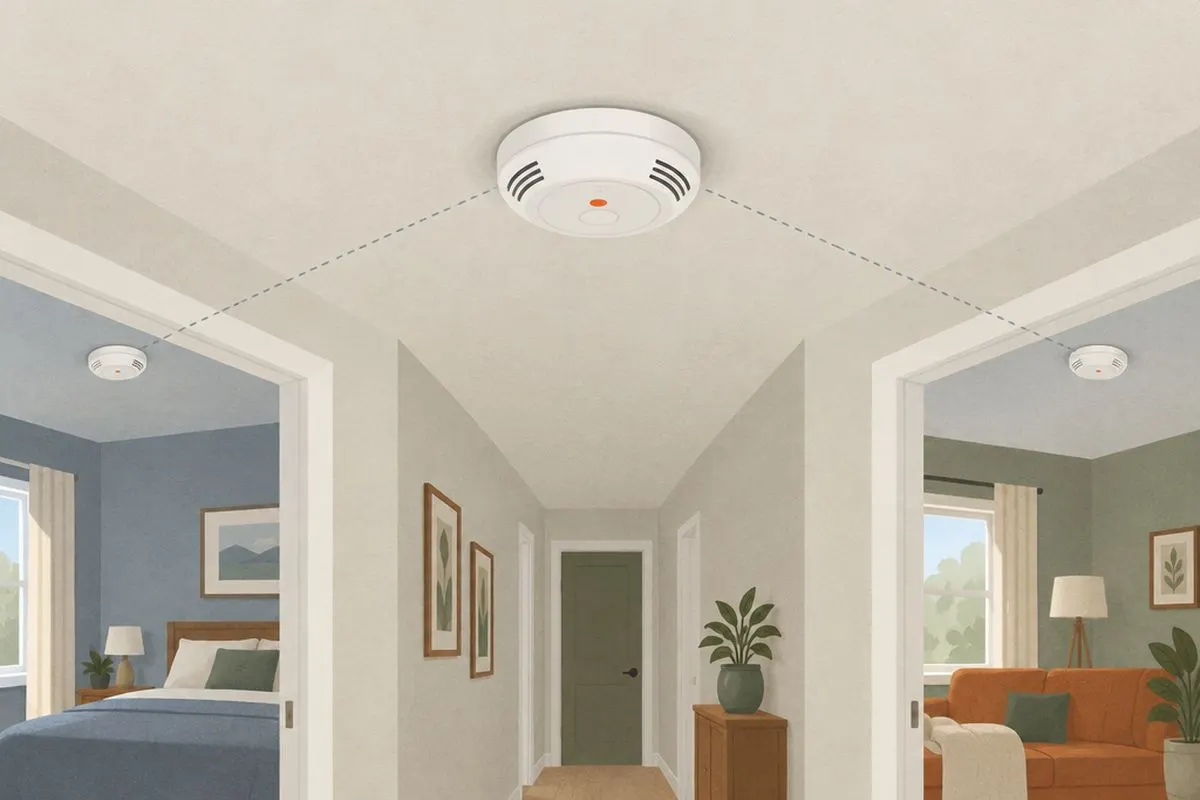
The most useful single table combines them with alarms. Deaths per 1,000 reported home structure fires: 13.0 with no alarm and no sprinklers, 8.5 with a battery alarm, 3.8 with hardwired alarms, and 1.0 with hardwired alarms and sprinklers together.
Read that last line carefully, because it is also an argument about order. Going from nothing to hardwired alarms takes you from 13.0 to 3.8. Adding sprinklers takes you from 3.8 to 1.0. Both are large; only one of them costs a few hundred dollars.
How to read those numbers honestly
NFPA flags its own caveats and they matter. These are estimates derived from fire incident reporting and scaled by survey, not a controlled trial. The protection-level table is based on presence, not operation. And sprinklered homes are systematically different from unsprinklered ones — newer, built to later codes, in wealthier areas, often with different lot layouts.
NFPA also notes a reporting bias: minor fires in homes with monitored detection are more likely to generate a fire department response and therefore more likely to be counted at all.
So 89% is a strong association rather than a clean causal estimate. We looked for an independent peer-reviewed meta-analysis and could not find one — the evidence base is NFPA's incident data plus advocacy material from both the sprinkler industry and the homebuilder lobby, each of which has spent heavily on this question. That is worth knowing before you accept any number in this debate, including the ones we have just quoted.
What NFPA 13D actually is
The residential standard is deliberately modest. Its stated purpose is life safety — getting people out — rather than saving the building. It designs for the two most demanding sprinklers running for ten minutes, or seven for a single-storey home under 2,000 sq ft, and it usually runs off the domestic water supply rather than a dedicated fire service.
That is a very different animal from a commercial NFPA 13 system, which is designed for property protection over a much longer duration with a dedicated supply.
It also permits omissions that a homeowner should know about. Sprinklers can be left out of garages, attics, crawlspaces, small bathrooms and small closets. Your attached garage — a common fire origin — is generally outside the system.
The objections that do not survive the data
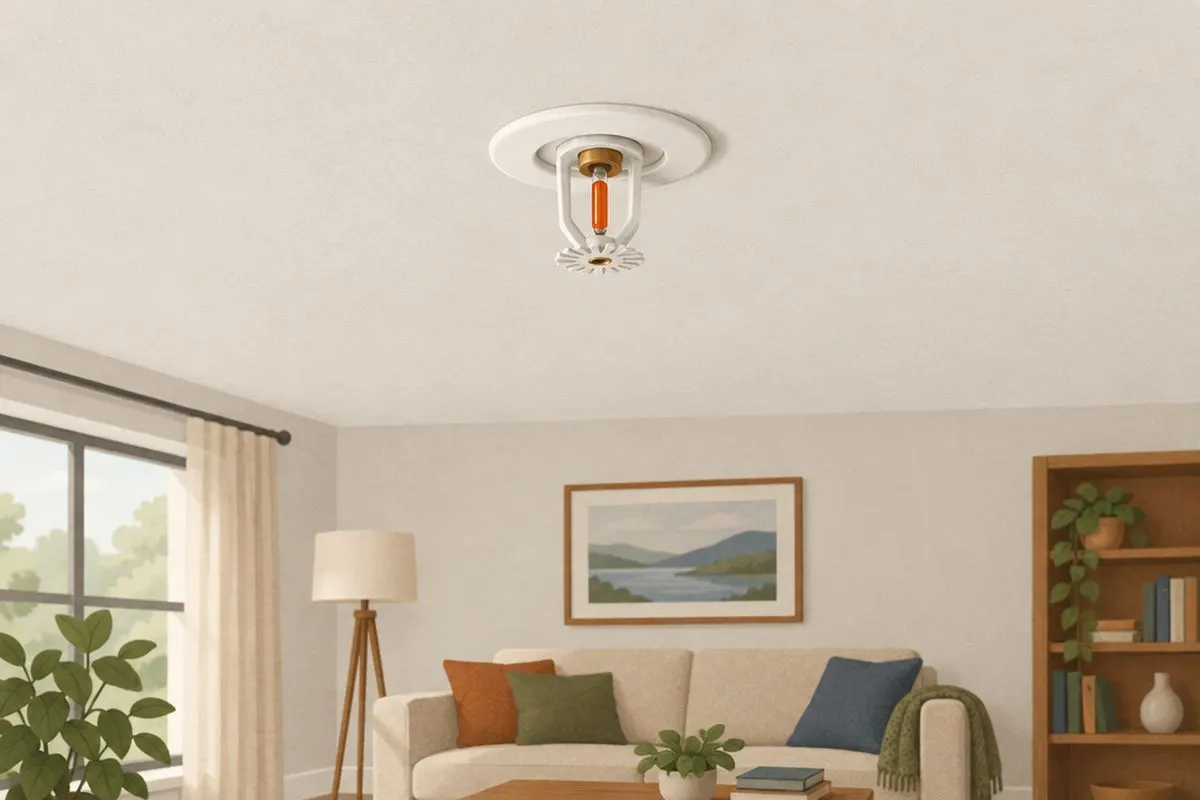
They will all go off at once. No. Each head holds back water with a heat-sensitive element that fails at its own rated temperature, so only the head over the fire opens. In NFPA's home fire data, one head operated in 85% of cases and five or fewer in 99.2%.
The water damage will be worse than the fire. The honest answer is not a hose-flow comparison but NFPA's loss figure: average property loss was 55% lower where sprinklers were present. That number already nets out whatever water damage the sprinklers caused.
Burnt toast will set them off. Sprinklers respond to heat, not smoke — a smoke alarm and a sprinkler head are triggered by entirely different things. We could find no authoritative statistic on cooking-steam activation, so we will not give you one, but the mechanism makes it implausible.
They go off accidentally. The widely quoted odds of one in sixteen million refer specifically to a manufacturing defect, which is not the same as real-world discharge. Actual causes, in NFPA's data, are overheating from a nearby heat source, freezing, mechanical damage, corrosion and vandalism — and the counts circulating online are across all occupancies, dominated by commercial buildings, so do not read them as a residential rate.
The objections that do survive
Retrofit cost. This is the real one. The canonical new-construction figure is USD $1.61 per sprinklered square foot from a Fire Protection Research Foundation study — though that study is from 2008 and should be treated as a historical anchor. Contractor data in 2026 suggests roughly USD $700 to $1,200 for new construction on a typical house against USD $3,000 to $4,500 for the same house retrofitted. Three to four times, because retrofit means opening finished ceilings and often upsizing the water service.
Water supply, if you are on a well. On a municipal main the system usually runs off the domestic supply and the cost stays reasonable. On a well, guaranteeing the ten-minute demand may need a stored tank and a pump, and that can dominate the budget. Price the water before you price the pipework.
Freezing, which is the serious objection in Canada and the northern US. NFPA 13D allows a wet system where the water and ambient temperature stay above freezing and a dry, air-pressurised system where they do not. Failures concentrate in attics, crawlspaces and exterior wall runs, particularly during power outages or a furnace failure. A dry system adds a compressor, air pressure supervision and more to maintain. For a seasonal or vacation property in a cold climate this objection has real teeth.
And the failure mode that dwarfs all the technical ones: in NFPA's data, 61% of sprinkler failures were systems that had been shut off before the fire. The most important maintenance action anyone takes with a sprinkler system is leaving the control valve open.
Where they are required
The International Residential Code has required sprinklers in new one- and two-family homes since its 2009 edition, but adoption is where the fight happened and most states adopted the IRC while stripping that requirement out.
Statewide requirements for new one- and two-family homes exist in California, Maryland and Washington DC. Around 29 states prohibit local mandates outright and roughly 19 allow local adoption — Scottsdale, Arizona has required them since 1986. Pennsylvania actually repealed its mandate in 2011, retroactively, and Minnesota's was overturned in court.
In Canada there is no national or provincial requirement for single-family houses. The notable exception is municipal: Vancouver has required sprinklers in one- and two-family dwellings since 1990, and a handful of other BC municipalities have followed. We could not find an authoritative national list, so check with your own municipality rather than assuming.
If you are in a jurisdiction that requires them, the cost question largely answers itself. If you are not, it is a genuine judgement call.
They do nothing about wildfire
This needs saying plainly because the words overlap and the products do not.
An NFPA 13D system is an interior life-safety system. Its heads open when the air at the ceiling inside a room gets hot. Wildfire destroys houses from the outside — embers into vents and gutters, radiant heat through windows, a neighbouring structure burning. By the time an interior head opens, the inside of your house is already on fire, which means the exterior defence has already failed.
The timeline does not work either. Ten minutes of water is meaningless against an ember shower that lasts hours, and in a wildfire the house is usually evacuated and the power — and therefore any well pump — is usually out.
Exterior wildfire sprinklers are an entirely different product, and even those come heavily qualified: NFPA's own wildfire research notes they can help a home survive but that effectiveness is questionable when a neighbouring home is burning, that they need water for up to eight hours, and that the high winds which drive destructive wildfires disperse the spray. Fire Safe Marin goes further and does not recommend them at all, noting that running exterior sprinklers can reduce water pressure for the whole neighbourhood.
If a contractor offers you an interior sprinkler system as wildfire protection, that is a reason to find a different contractor.
So — do you need them?
If you are building or gutting a floor, yes, we would put them in. The evidence is the best in home fire safety, the marginal cost during construction is small, and you will never get this price again.
If you have an existing finished house and a fixed budget, the order the data suggests is: hardwired interconnected alarms first, because they take you most of the way down the death rate for a fraction of the cost. Then the rest of the basics. Then sprinklers at the next major renovation.
The case for retrofitting anyway is strongest where someone in the house would struggle to self-evacuate — a person with limited mobility, or an occupant who cannot be relied upon to wake and act on an alarm. That is the scenario 13D was designed around, and it is the one where an alarm alone is not enough.
Do not expect insurance to pay for it. Discount claims in this category are almost entirely advocacy-sourced, and we could not find a single insurer or regulator publishing a residential sprinkler discount schedule in either country. Ask your own insurer for a specific number before you count on one.
Sources
NFPA, 'US Experience with Sprinklers', April 2024, covering 2017-2021 incident data — all effectiveness, activation and failure figures. NFPA 13D as described in fire protection industry technical guidance. Fire Protection Research Foundation, Home Fire Sprinkler Cost Assessment (2008) for the per-square-foot figure.
QRFS analysis of US state adoption and the residential sprinkler mandate conflict; ProPublica's reporting on the homebuilding industry's campaign against mandates; City of Vancouver council records on the 1990 adoption. NFPA wildfire research fact sheet on exterior sprinklers, and Fire Safe Marin on exterior sprinklers and coatings.
Advocacy sources on both sides — the Home Fire Sprinkler Coalition and the homebuilder associations — have been read but not relied on for numbers. Current as of September 2026.