
Residential Fire Sprinklers
For the fire that starts inside. Not for the one outside.
An NFPA 13D system is a life-safety device: it is designed around one or two heads running for ten minutes, long enough to get everyone out. The evidence behind it is the strongest in home fire safety — NFPA's analysis of five years of US fire data puts the death rate 89% lower and average property loss 55% lower where sprinklers were present. Two things to be clear about before you read further. Only one head operates in 85% of home fires, so the flooding fear is misplaced. And these have essentially nothing to do with wildfire, which attacks the outside of the house; do not let anyone sell you one as wildfire protection.
Our picks
2 guides · price bands $ to $$$$
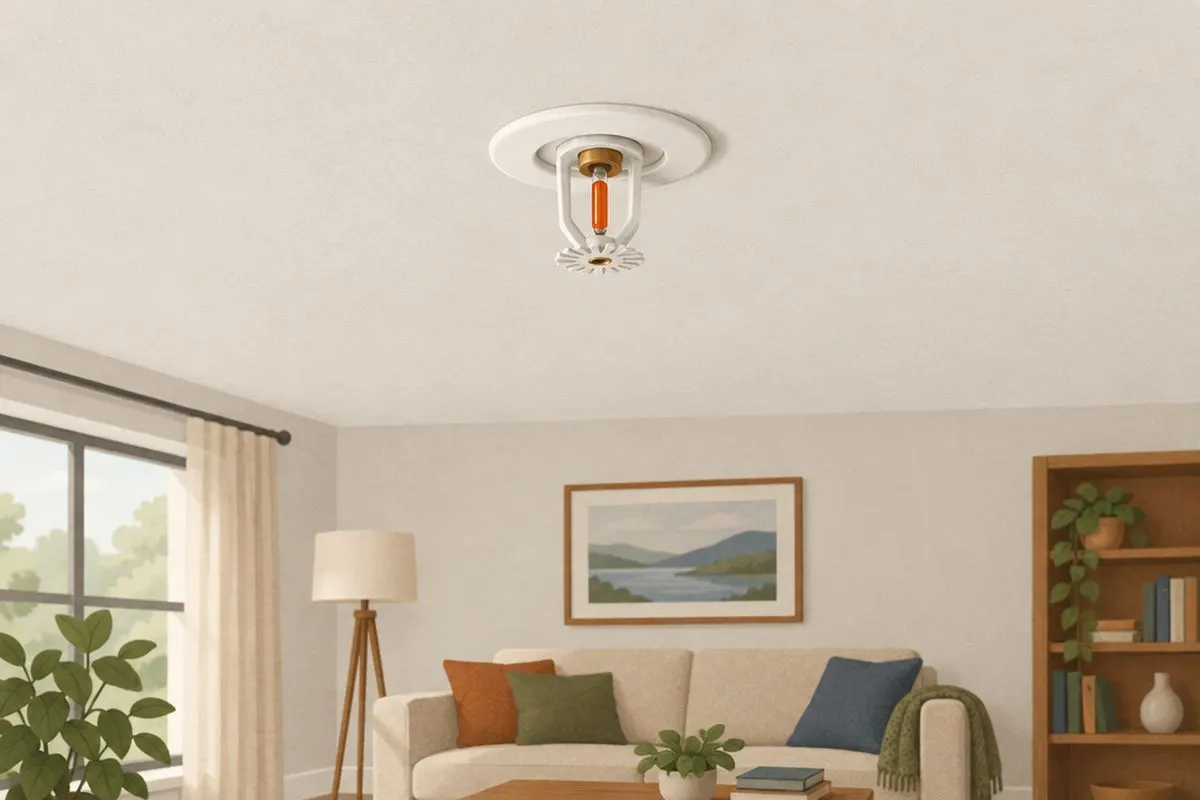 Illustration
Residential Sprinkler System (NFPA 13D)
An interior sprinkler system designed to the residential standard: one or two heads running for ten minutes, enough to hold a fire while everyone gets out. It is a life-safety system, not a property-protection one, and it does nothing about wildfire.
Plumis Automist Targeted Water Mist
A wall- or under-cabinet-mounted unit that detects a fire and aims a high-pressure water mist at it from a rotating head, using mains water and a small pump. It is marketed as a lighter alternative to home sprinklers; Canadian availability is not confirmed.
Before you buy
- Retrofit costs roughly three to four times new construction for the same house, because it means opening finished ceilings. If you are building or doing a gut renovation, this is the only moment the price is reasonable.
- The single biggest failure mode is not technical. In NFPA's data, 61% of sprinkler failures were systems that had been shut off before the fire. The most important maintenance task is leaving the control valve open.
- A 13D system does not cover your garage, attic or crawlspace — all common fire origins. It is protecting escape routes and living space, not the whole building.
- In a cold climate, ask specifically about freezing. Failures concentrate in attics, crawlspaces and exterior wall runs during power outages, and the dry-pipe alternative brings a compressor and more moving parts to maintain.
- On a well rather than a municipal main, the stored-water tank and pump needed to meet the ten-minute demand can dominate the budget. Price the water supply before you price the pipework.