Independent and reader-supported. Some links are affiliate links — see our disclosure. Codes vary by province, state and city: confirm with your local fire authority.
For drafting without a fixed hydrant

Hard Suction Hose & Low-Level Strainer

Various Canada & United States $$ · Per 10 ft section plus strainer

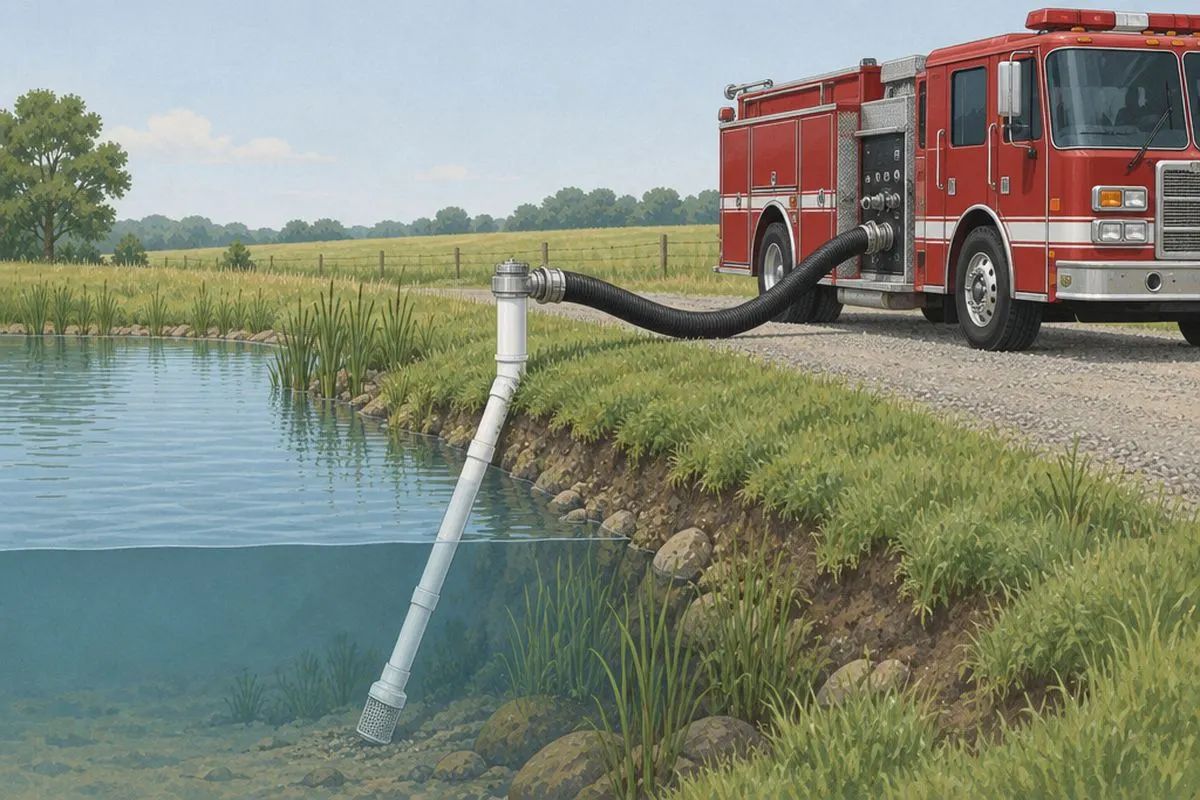
Rigid, non-collapsing hose that lets a pump draw from an open water source, with a strainer that keeps debris out and prevents the vortex that loses your prime. The portable alternative to a fixed dry hydrant.

Why we like it

  • Works at any accessible water source — no civil works
  • Low-level strainers can draft from shallow water a fixed intake could not reach
  • Far cheaper than an installed hydrant

Watch out for

  • Someone has to be there to deploy it, and it is heavy
  • Bank access and lift still govern whether it works at all
Best for

Properties with a seasonal or awkward water source, and anyone running their own fire pump.
Read the full market guide — costs, install effort and alternatives ↓
Market guide

The whole commitment, end to end

What this actually is, what the market looks like, what it really costs, and how much of your time it wants — before you spend anything.

Buying it Moderate
Installing it Easy
Living with it Easy
Up front

CAD $300-$900 for a practical setup — one or two sections plus a strainer.

Lead time

2-6 weeks from distributors

Time to install

10-20 minutes to deploy once you have practised

How it works

Ordinary fire hose collapses under vacuum, so drafting needs rigid hose with an internal helix. The strainer on the end keeps debris out of the pump and, in a low-level design, lets you draw from only a few inches of water without pulling air. Pulling air is the whole failure mode: lose prime and the pump stops moving water until you re-prime.

What the market looks like

Sold by forestry and firefighting supply distributors in 10 ft sections, typically CAD $200-$600 per section depending on diameter and construction, with strainers from CAD $80 for a simple barrel type to CAD $400 for a low-level or floating design. Diameter is dictated by your pump's intake. A genuine performance note worth knowing: going from 4 inch to 6 inch suction can improve pump capacity by 20-25%, which is a larger gain than most equipment upgrades at the same money.

Features that actually matter

Non-collapsing construction
The defining feature. Garden hose or standard fire hose will flatten under vacuum and move nothing.
Low-level or floating strainer
Lets you draft from shallow or silty sources. A barrel strainer resting on the bottom of a pond will pull mud; a floating one will not.
Thread compatibility
Must match your pump's intake, and ideally your fire department's, under NFPA 1963. Mismatched threads are the classic day-of failure and no adapter is ever where you left it.
Section length
Standard 10 ft sections. Total run matters because every foot adds friction and every joint is a potential air leak.

What it really costs

Up front
CAD $300-$900 for a practical setup — one or two sections plus a strainer.
Consumables
Gaskets, which perish and are the usual cause of a lost prime.
What else you'll need
A pump. Without one this is inert.
Over five years
Gaskets and the occasional fitting. Well-stored suction hose lasts decades.

Figures are typical street prices in Canadian and US dollars as of September 2026, gathered from public retail listings. They move with the season and with the exchange rate — treat them as a planning band, not a quote.

How it differs from the alternatives

Versus a fixed dry hydrant
A tenth of the cost and infinitely more flexible, but it requires a person on the bank at the time. A dry hydrant works for a crew that arrives when you are already gone.
Versus a tank
Unlimited supply against a known finite one, at the cost of needing an accessible source with enough depth. Most rural properties want both paths.
The lift rule applies equally
Portable or fixed, the pump still cannot lift water more than about 22 ft in ideal conditions, and considerably less in practice at altitude. Measure the vertical drop from your pump position to the water before you buy anything.
01

Buying it

Effort Moderate

Where: Forestry and firefighting supply houses, wildfire equipment specialists, some marine suppliers.

Lead time: 2-6 weeks from distributors

Match the diameter to your pump's intake first and everything else second. Buy the gaskets and any adapters in the same order.

02

Installing it

Effort Easy

Time: 10-20 minutes to deploy once you have practised

You'll need: Spanner wrenches · Rope for the strainer · Gloves

Practise on a calm day. Find out then whether your chosen bank is actually workable, whether the strainer sits deep enough, and how far the hose really reaches. Tie the strainer off so it cannot settle into the silt.

03

Living with it

Effort Easy

Dry it thoroughly and store it straight and out of sunlight. Check gaskets annually. A stored-wet section develops leaks at exactly the joints you will not test again until you need it.

If not this, then what

  • A fixed dry hydrantNo deployment, works without you, far more expensive and needs approval.
  • A poly tank with a flooded suctionRemoves the lift problem entirely by putting the water above the pump.
Our verdict

The right complement to a portable fire pump, and the cheapest way to make a pond useful. Check your vertical lift before you buy, and buy the suction diameter your pump actually wants.

We don't take payment for placement and we don't sell these products. If you think we've got something wrong here, tell us — we'll correct it.