
How Far Should Trees Be From Your House?
The official setbacks in Canada and the US, what the research actually found, and why 'cut down all your trees' is the wrong answer.
The short answer
Nothing combustible within 1.5 metres (5 feet) of the wall, and no conifer within 10 metres (33 feet), is the rule most Canadian homeowners should work to. Beyond that, thin rather than clear: FireSmart Canada asks for 3 metres of space between tree crowns out to 30 metres, and for branches pruned 2 metres up from the ground.
But the more useful answer is that distance is not really the variable. What matters is whether there is a continuous path of fuel from the forest to your wall, and whether anything is touching or overhanging the house. A well-spaced, well-watered deciduous tree 8 metres from the house is a different proposition from a dead spruce the same distance away with its lower branches sweeping the ground and a bed of bark mulch underneath.
This guide gives the official numbers for both countries, then looks at what the post-fire research found — which is more nuanced, and in places more forgiving, than the guidance implies.
What FireSmart Canada actually says
FireSmart uses three named zones, not numbers. The Immediate Zone runs from the wall out to 1.5 metres. The Intermediate Zone covers 1.5 to 10 metres. The Extended Zone runs 10 to 30 metres. You will often see them written as 'Zone 1, 2, 3', borrowing CAL FIRE's numbering, but the names above are what FireSmart itself publishes.
In the Immediate Zone, FireSmart asks for a non-combustible surface — gravel, rock, pavers — extending around the entire house and around any attachment, including decks. Avoid woody shrubs and trees entirely. Even fire-resistant plants should sit no closer than 1.5 metres to a structure.
For trees specifically: coniferous trees should not be within 10 metres of the home. Prune all branches to 2 metres from the ground, on every tree within 30 metres and, if you can manage it, out to 100 metres. In the Extended Zone, selectively remove evergreens so there is at least 3 metres of horizontal space between crowns or groups of crowns. Firewood moves out to the Extended Zone too.
One rule that surprises people because it reaches well past the non-combustible strip: no bark or pine-needle mulch within 10 metres of the house. Not 1.5 metres — 10. Bark mulch is one of the most reliable ways to carry a spot fire to a wall, and it is sold at every garden centre in the country.
FireSmart is also unusually direct about species. Deciduous trees — poplar, birch, aspen — are listed as less flammable and appear under 'trees to plant'. Conifers — spruce, fir, pine, cedar — are listed as highly flammable and appear under 'plants to avoid'. That distinction does not exist in the California guidance.
What CAL FIRE requires in the US
California uses three numbered zones in feet, and unlike FireSmart's voluntary guidance, the 100-foot requirement is law under Public Resources Code 4291. Zone 0 is 0 to 5 feet. Zone 1 is 5 to 30 feet. Zone 2 is 30 to 100 feet, measured from structures and decks or to the property line, whichever comes first.
Tree spacing in Zone 2 varies with slope, which is the sensible part of the California approach and something FireSmart does not do. On slopes up to 20% you need 10 feet of horizontal space between canopy edges. From 20 to 40%, 20 feet. Above 40%, 30 feet. Fire moves uphill faster, so steeper ground needs wider gaps.
Branches get cleared to at least 6 feet from the ground — the Board of Forestry's own guidance says 6 to 15 feet, or the lower third for small trees. And remove every branch within 10 feet of a chimney or stovepipe. FireSmart has no equivalent chimney rule, so if you are in Canada and reading American sources, that 10-foot figure is not something FireSmart asks of you.
Zone 0 — the ember-resistant first five feet — is the piece everyone is waiting on. The Board of Forestry adopted the regulation on 19 August 2026 and filed it with the Office of Administrative Law on 28 August, then withdrew that filing on 8 September before the state ruled on it. No reason was published and the Board can refile. So as of early October 2026 it is not in force and there is no statewide effective date; existing defensible-space law and any local Zone 0 ordinance still apply. When it does take effect, new construction complies immediately and existing homes get a phased window of three to five years. It bans combustible mulch, firewood, debris and combustible outbuildings in the first five feet, but — contrary to a lot of early reporting — it does not ban all plants there. Maintained grass, low groundcover, herbaceous plants and potted plants in non-combustible containers are permitted, as are existing trees that meet the maintenance rules.
If you are in California, check the Board of Forestry's defensible space page before acting on any Zone 0 deadline you read elsewhere, including this one. It is the fastest-moving rule in wildfire policy right now.
What the research found, which is not quite what the rules say
The most important study on this question looked at thousands of homes across Californian fires and asked how far clearance actually needs to extend. The finding: clearance of roughly 5 to 20 metres was the effective range, depending on slope, and distances beyond 30 metres provided no additional protection at all — not even for houses on steep slopes. The steepest gain came from going from almost no clearance to 8 to 15 metres.
The same work found that at least 60% of the woody vegetation on a property could remain with significant protective benefit intact. Effective clearance covered under 40% of the typical lot. What was strongly significant was vegetation touching or overhanging the structure.
That is a different message from 'clear everything'. It says: be ruthless close in, thin sensibly in the middle distance, and stop worrying past 30 metres.
A study of the 2018 Camp Fire complicates it further. Higher canopy cover within 30 to 100 metres did reduce survival — homes built after 1996 survived at 77% where canopy cover was under a third, and at 24% above that. But the authors attributed most of the effect to accumulated leaf and needle litter rather than to the canopy itself burning. And the single strongest predictor in that study was not vegetation at all. It was distance to the nearest destroyed building.
Trees are not always the enemy
Two pieces of recent work should give pause to anyone about to call an arborist in a panic.
A USDA Forest Service team looked at around 16,000 buildings across the Ventura and Paradise fires. Dry, water-stressed vegetation near buildings was associated with loss, as you would expect. But in Ventura, buildings near trees that were not water-stressed had a better chance of surviving. The researchers argued for location-specific guidance rather than blanket rules.
A UCLA team surveying more than 2,000 trees in the Palisades and Altadena burn scars found something more pointed: mature trees frequently carried fire scars on the side facing a destroyed house. The tree caught fire from the building, not the other way round.
None of this overturns the close-in rules. The Insurance Institute for Business & Home Safety ran seventeen experiments and found that vegetation within five feet of a house significantly increases heat exposure during a fire and can amplify damage even when the plants are well watered — which contradicts the common belief that irrigation makes landscaping safe. Where more than a quarter of the first five feet was covered in fuel, the risk of damage or destruction approached 90%.
The reconciliation is straightforward once you see it. The first few metres are decisive. The far field is not. Those are two different questions and a lot of advice runs them together.
A caution about reading across the border
Almost all the research above is Californian — chaparral and mixed conifer, in a Mediterranean climate. FireSmart's 10-metre conifer setback is aimed at boreal spruce and pine, where crown fire behaves differently and moves faster. If you are in northern Alberta or the BC interior, do not let a California study talk you out of the conifer rule.
The other cross-border traps are the units and the mulch rule. FireSmart bans bark mulch to 10 metres; California's Zone 0 rule bans it to 5 feet. That is a very large difference, and it is the single most likely place for a homeowner reading both countries' guidance to get it wrong. FireSmart prunes to 2 metres, CAL FIRE to 6 feet — close, but not the same number. And FireSmart's outer zone stops at 30 metres where California's goes to 100 feet, which is roughly the same distance by coincidence rather than design.
 Illustration
Battery Pole Saw
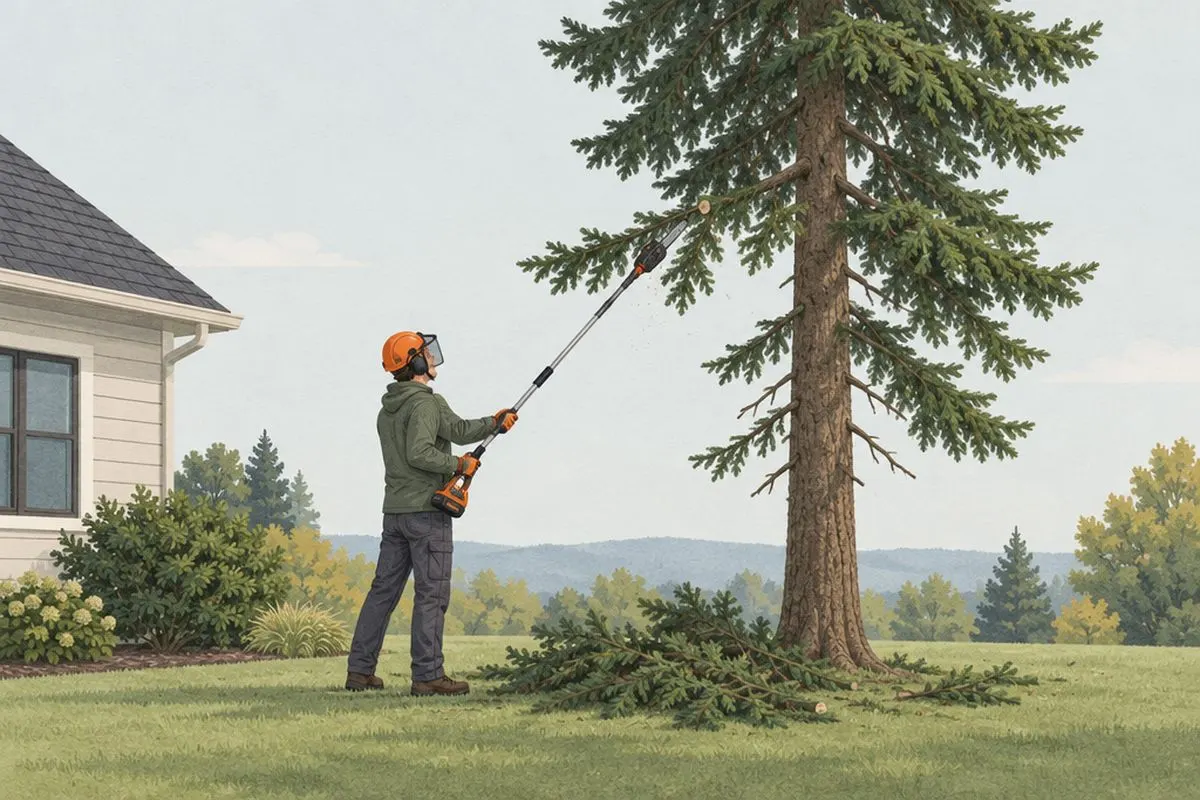
Limbing conifers to 2 m (6 ft) off the ground removes the ladder fuel that carries a ground fire into the canopy. A battery pole saw makes it a weekend job instead of a contractor call.
 Illustration
McLeod Fire Rake / Hoe
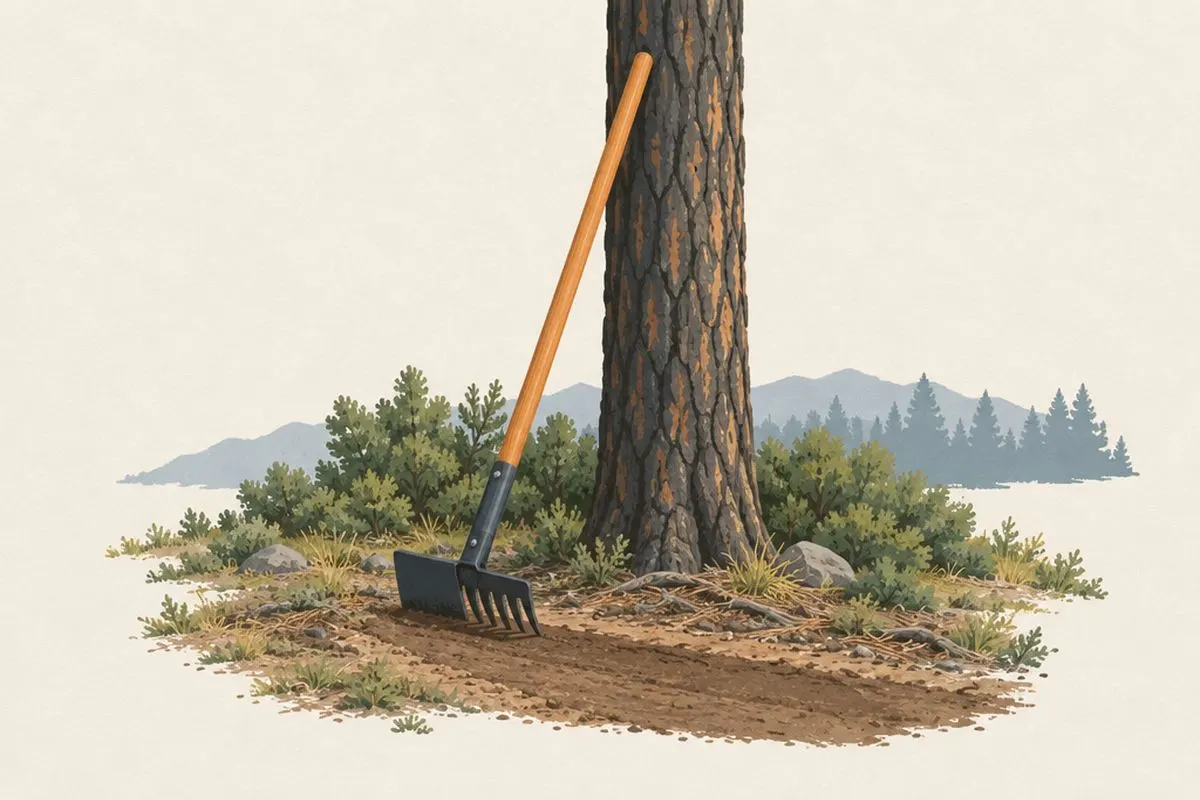
The combination rake-and-hoe wildland crews use to scrape fuel down to mineral soil. Ideal for clearing needle litter, cutting a small control line and smothering spot fires.
What to actually do this spring
Start at the wall and work outward, because that is the order the payoff comes in. Strip the first 1.5 metres to gravel or bare mineral soil. Pull the bark mulch — all of it, out to 10 metres if you are in Canada. Move the woodpile past 10 metres. Clear the roof and gutters of needle litter, and cut back anything touching or overhanging the house.
Then prune. Branches to 2 metres up on everything within 30 metres. Take out the conifers inside 10 metres if you can bring yourself to, starting with any that are dead, dying or leaning toward the house. Thin the rest to 3 metres between crowns.
Then stop. Past 30 metres you are spending weekends for no measurable return, and the evidence says so plainly. If you still have energy, spend it on the house — vents, gutters, the first five feet of deck — rather than on more trees.
 Illustration
1/8 in Stainless Steel Ember Mesh
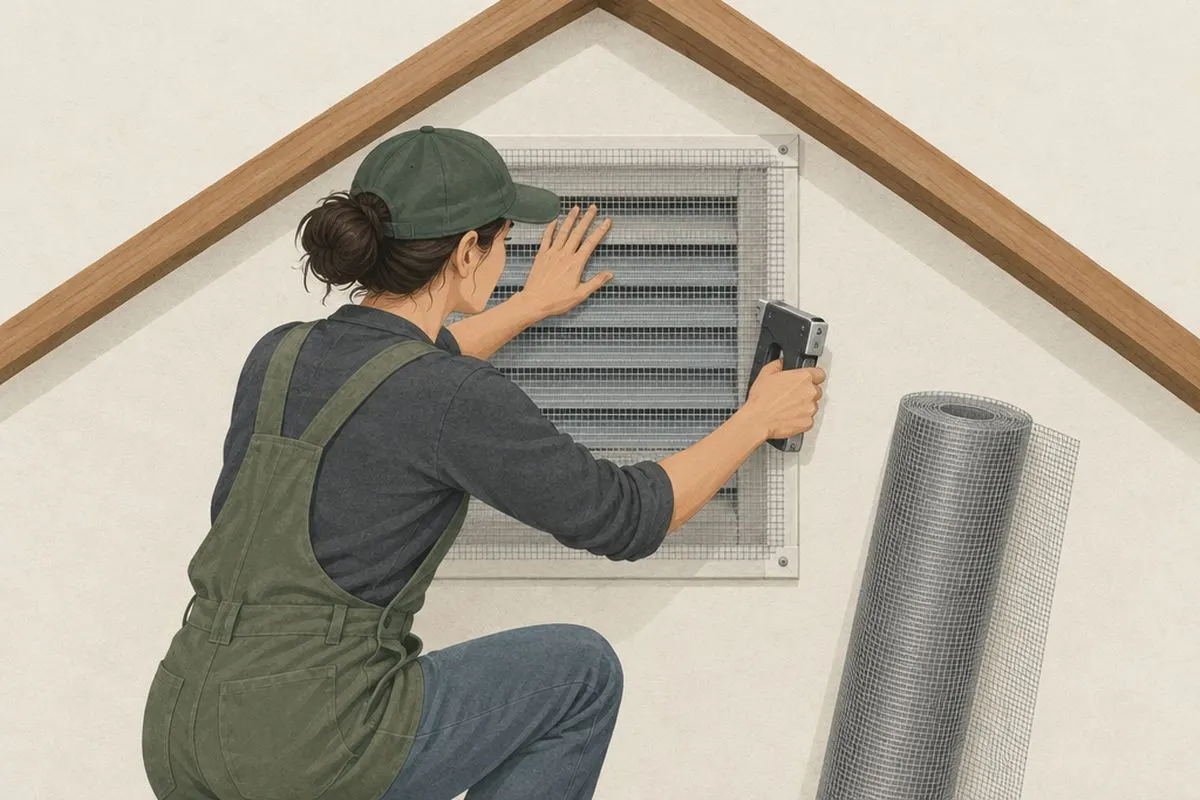
A roll of 1/8 in (3 mm) stainless mesh stapled or screwed over existing vents is the recommended retrofit when replacement isn't practical. Also use it to close gaps under decks and at the base of siding.
 Illustration
Stainless Micro-Mesh Gutter Guard
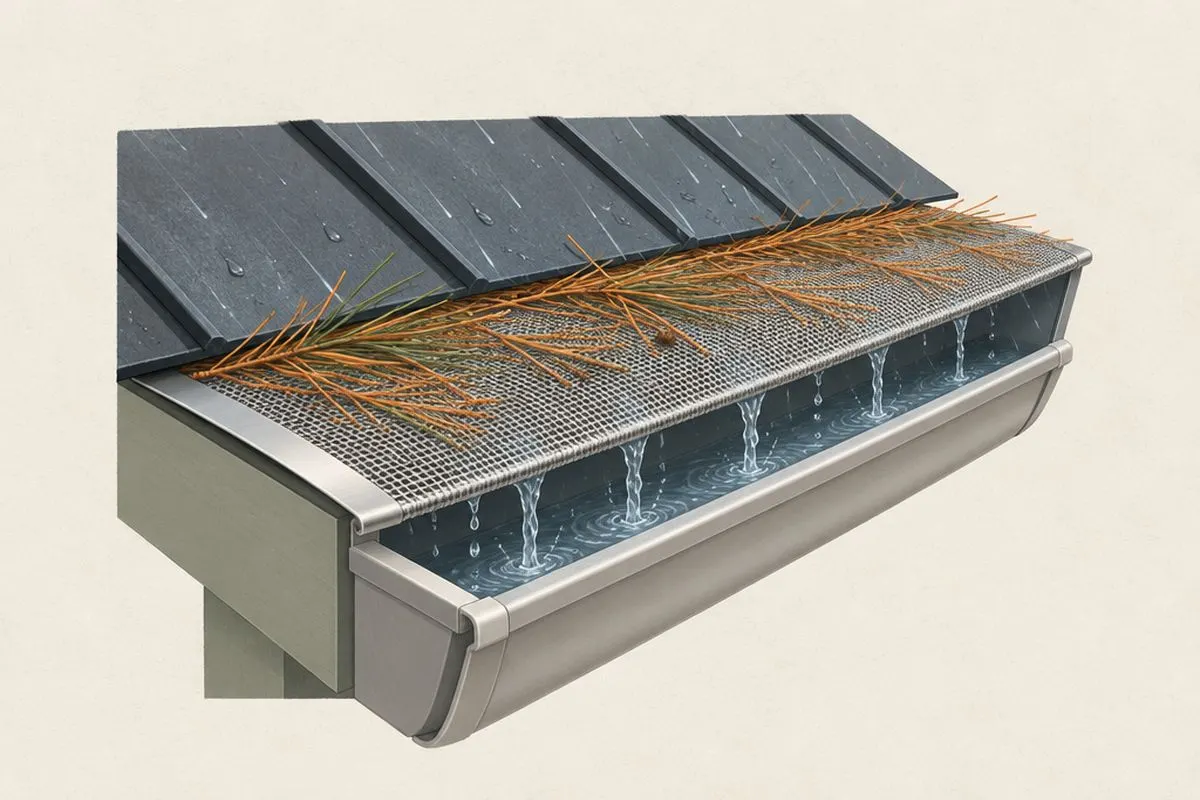
Stainless micro-mesh on an aluminum frame blocks pine needles and seeds while letting water through. Non-combustible by design, which is the whole point in a wildfire zone.
Sources
FireSmart Canada, 'FireSmart Begins at Home' guide and Home Ignition Zone pages. FireSmart BC landscaping best practices. CAL FIRE 'Ready for Wildfire' defensible space pages and Public Resources Code 4291. California Board of Forestry and Fire Protection, defensible space zones and the August 2026 Zone 0 rulemaking.
Syphard et al., 'The role of defensible space for residential structure protection during wildfires', International Journal of Wildland Fire. Knapp et al., 'Housing arrangement and vegetation factors associated with single-family home survival in the 2018 Camp Fire', Fire Ecology 17:25 (2021). Insurance Institute for Business & Home Safety research on Zone Zero fuel coverage and near-home vegetation. USDA Forest Service and UCLA post-fire tree surveys reported via LAist.
Figures current as of September 2026; Zone 0 status checked 2 October 2026. Zone 0's status in California changes frequently — verify before relying on a date.