
Smoke and CO Alarms: What to Buy and What the Law Says
The evidence on what actually works, and the placement and CO rules for Ontario, BC, Alberta, Quebec and the US — which differ more than you would expect.
The number that should decide your purchase
In NFPA's analysis of US home fires, smoke alarms operated in 93% of fires when they were hardwired and 79% when they ran on batteries alone. The gap is almost entirely human. Of alarms that failed, 47% had a missing or disconnected battery and 24% a dead one. Power supply failure accounted for 7%.
So the ranking falls out of the data rather than out of marketing. Hardwired with battery backup and interconnected is best. A sealed ten-year lithium unit is the best retrofit, because it removes the failure mode that causes most failures. A replaceable nine-volt alarm is the worst of the three, and several US states — California, Florida, Maryland, New Jersey and New York among them — have concluded as much and banned the sale of battery-only alarms that are not sealed ten-year units.
The other number worth carrying around: the death rate is 0.53 per 100 fires with a working alarm and 1.18 without. Roughly half. Nothing else in home fire safety is that cheap for that much.
 Illustration
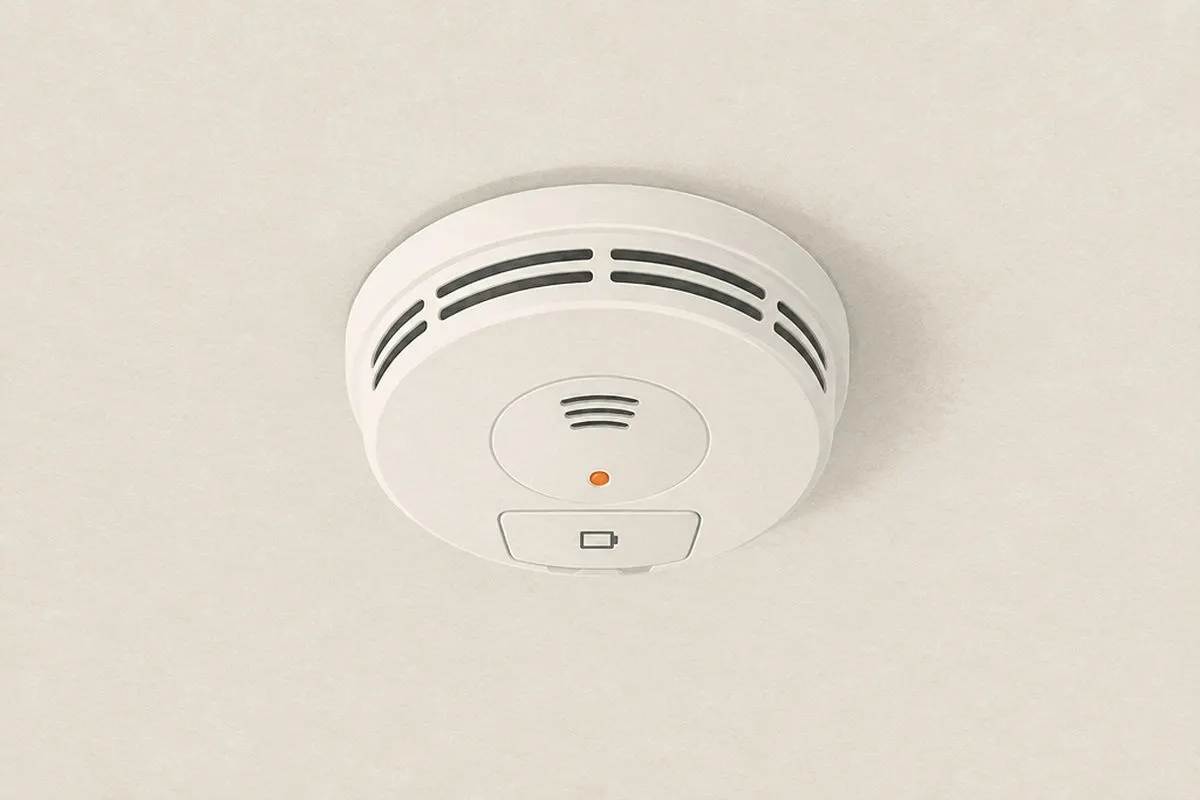
10-Year Sealed Battery Smoke Alarm
A battery alarm with a lithium cell sealed inside for the unit's full ten-year life. You cannot remove the battery, which is precisely the point: a missing or dead battery is the reason most failed alarms failed.
 Illustration
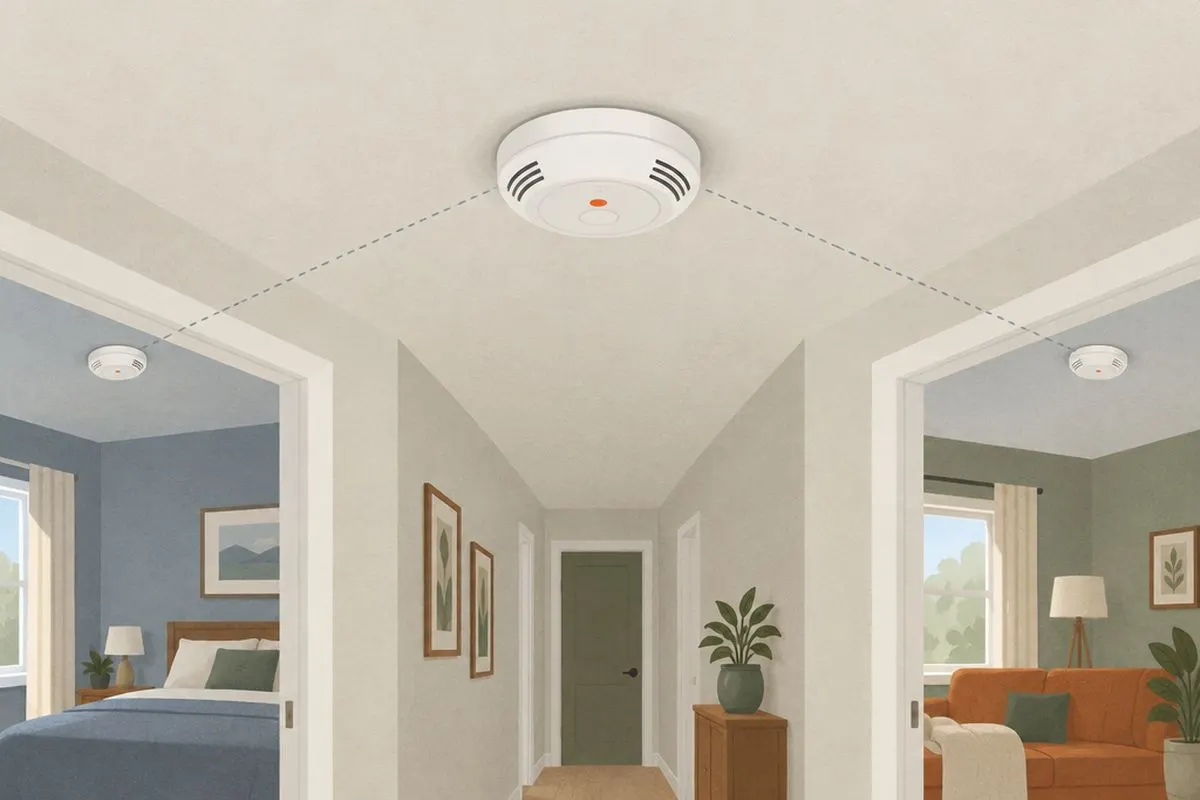
Hardwired Interconnected Smoke Alarm
Mains-powered with battery backup, wired so that any one alarm sets off every alarm in the house. This is what building codes require in new construction in both countries, and the configuration that performs best in real fires.
Ionisation, photoelectric, and why the question has moved on
The old debate is real but settled and, at this point, slightly beside the point. Ionisation alarms respond faster to fast-flaming fires; photoelectric respond faster to smouldering ones. NIST's full-scale testing found both gave adequate warning in most residential scenarios, while noting that escape times are shorter than they were in the 1970s because modern synthetic furnishings burn faster. USFA's recommendation is to have both technologies in the house, or dual-sensor alarms.
Two US states go further. Vermont has required photoelectric-only alarms near bedrooms since 2008, and does not permit ionisation-photoelectric combination units in those locations. Massachusetts requires photoelectric within 20 ft of a kitchen or bathroom.
But the better filter now is the standard. UL 217's 8th edition, effective June 2024, added a smouldering polyurethane test, a flaming polyurethane test, and a cooking nuisance test in which the alarm must not sound while two hamburger patties are broiled 10 ft away. When NIST tested 45 existing models against those criteria, not one met all of them — about three quarters met one or none. That forced a real redesign across the category, and it is a more meaningful purchase filter than sensor type.
One honest caveat, because it contradicts a lot of marketing: NIST's follow-up work found the new-standard alarms were not clearly better than the old ones at ignoring cooking. The hamburger test is a floor, not a cure.
Where they go
Placement is code rather than preference, and the model requirements are close enough in both countries to state once: an alarm on every storey including the basement, one inside each bedroom, and one in the hallway between the sleeping area and the rest of that storey.
Keep them away from the two things that cause nuisance alarms. Not within 3 ft of a bathroom door, because steam sets them off. And away from the stove — the US model code asks for at least 6 ft for photoelectric units and 20 ft for ionisation, or 10 ft if it has a hush button. An alarm that cries wolf every time you sear something is an alarm that ends up in a drawer.
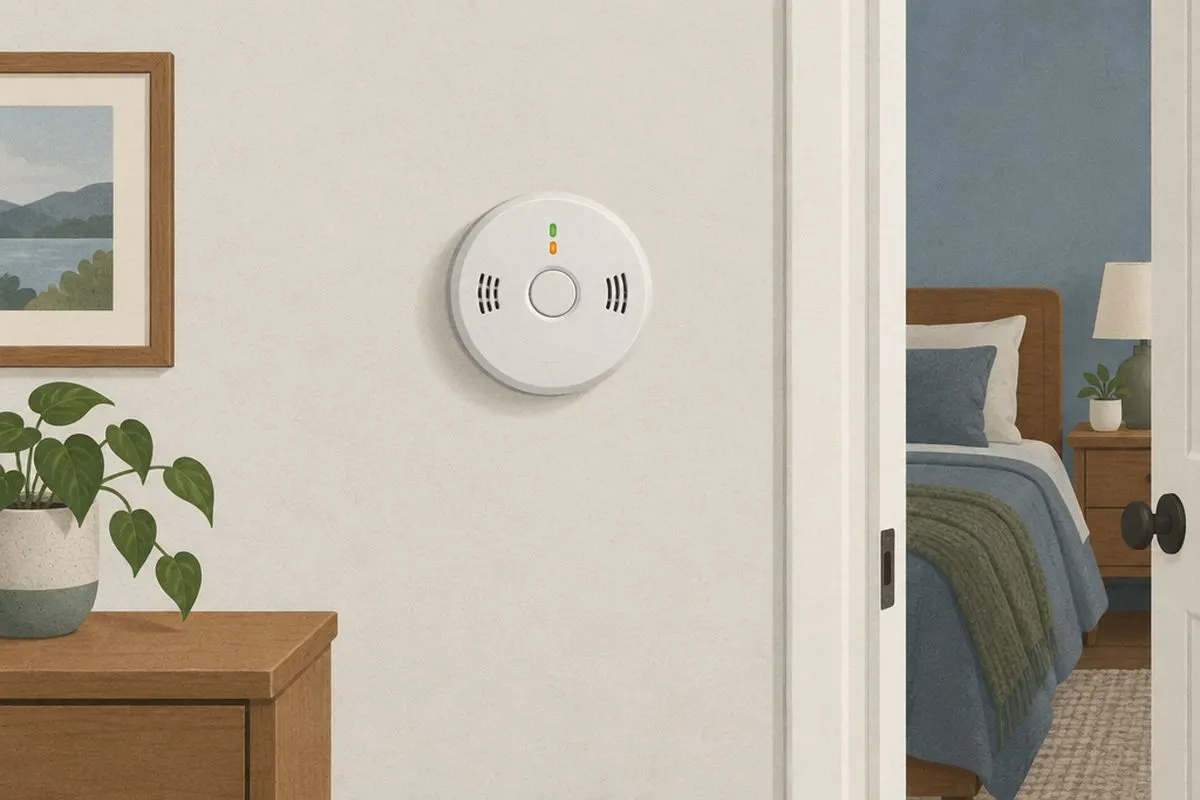
Smoke alarms belong on the ceiling. CO alarms are generally wall-mounted and 5 to 15 ft from any fuel-burning appliance. Those two ideals do not coincide, which is the genuine drawback of a combination unit that nobody mentions at the till.
Canada: what your province actually requires
Start with a distinction that catches people out. In Canada the Building Code governs new construction and the Fire Code governs existing buildings — and it is the Fire Code that binds you as a current owner or landlord. They are not the same document and they do not always say the same thing.
The national baseline under NBC 9.10.19.3 is an alarm on every storey including the basement, one in each bedroom, and one between the sleeping area and the rest of the storey, permanently wired with battery backup and interconnected within the dwelling. CO alarms under 9.32.4.2 are required where there is a fuel-burning appliance, inside each bedroom or within 5 m of each bedroom door, and do not need to be hardwired.
Ontario is the strictest and has just got stricter. The Fire Code requires working smoke alarms on every storey and outside all sleeping areas in every home, owned or rented. As of 1 January 2026 the CO requirement expanded from adjacent-to-sleeping-areas to every storey, including storeys with no bedrooms. Landlord duties are specific — provide and maintain, test annually and on turnover, supply maintenance instructions — and the penalties run to $50,000 for an individual and $100,000 for a corporation.
British Columbia follows the national structure for smoke alarms but its CO requirement is conditional rather than blanket: it applies where there is a fuel-fired appliance, an attached garage, or a shared wall or floor with a parking garage or a service room containing a fuel-fired appliance. Vancouver goes further than the province and requires CO alarms in all dwelling units, new and existing, hardwired and interconnected.
Alberta runs the 2023 Alberta Edition of the National Building Code, effective May 2024, with the familiar smoke alarm pattern. Its CO requirement is narrower than Ontario's, centring on rooms with solid-fuel appliances, and a 2023 municipal survey found no Alberta city formally enforcing it — most only recommend compliance. That is a real gap worth knowing about if you are buying in Alberta.
Quebec is where the most common misconception lives. There is no province-wide requirement to use ten-year lithium alarms — the electrical contractors' association has said so explicitly. What exists is municipal: the Montreal agglomeration by-law and Laval's equivalent require a non-removable ten-year lithium battery alarm in residential buildings built before 1985 that do not have 120 V alarms. That catches a very large number of Quebec homes, but it is a city rule, not a provincial one. Provincially, the RBQ requires alarms meeting CAN/ULC-S531 and replacement ten years from the date of manufacture — immediately if that date is missing or unreadable.
The United States
The model codes — NFPA 72 and IRC R314 and R315 — put alarms in every bedroom, outside each separate sleeping area, and on every storey including basements and habitable attics. New construction is hardwired with battery backup and interconnected, either by wire or by listed wireless. Where a renovation opens the walls, hardwiring is expected; where it does not, listed wireless-interconnected battery alarms are accepted.
Beyond that, this is state and often municipal law. California has required since July 2015 that every battery-powered smoke alarm sold in the state have a sealed, non-replaceable ten-year battery, which means replaceable-battery models are simply not on the shelves there. Florida, Maryland, New Jersey and New York have comparable sealed-battery requirements.
The place most Americans actually meet this law is at sale or transfer of a property, which is when Massachusetts and Vermont in particular require compliance certificates. If you are selling, find out early rather than three days before closing.
Interconnection, and an honest word about the evidence
Interconnection means any one alarm sounds all of them, so a basement fire wakes someone on the third floor. Both countries require it in new construction, and the mechanical argument is obviously sound.
What we could not find is a study isolating a survival benefit from interconnection specifically. NIST's work treats alarms as present or absent and does not separate interconnected from standalone. So the honest framing is: required by code, mechanically sensible, and not independently quantified. We would still do it, and we would not quote a number at you.
One wrinkle for Canadians: Ontario's 2024 Building Code permits wireless interconnection only in houses with secondary suites. For ordinary dwellings the code language still says wired, and other cases are handled by building officials through policy or an alternative-solution submission. If you are planning a wireless retrofit in Ontario, ask your building department before you buy.
The ten-year rule, which almost everyone breaks
Smoke alarms are replaced ten years from the date of manufacture printed on the back. Not ten years from installation, not when the battery dies, and not when it looks dirty. This applies to hardwired units as much as battery ones.
CO sensors are shorter-lived — manufacturers commonly rate them at seven years against the smoke alarm's ten. On a combination unit, the shorter life governs, and thinking in ten-year terms means running an expired CO detector for three years without knowing it.
The single most useful thing you can do after reading this page is to go and look at the back of every alarm in your house. Most homes have at least one that is older than the people living there believe, and a fifteen-year-old alarm is not a slightly worse alarm — it is decoration.
Sources
NFPA, 'Smoke Alarms in US Home Fires'. NIST Technical Note 1455-1 on home smoke alarm performance, and NIST's 2024 work on new-standard alarms and cooking nuisance. CPSC/NIST contractor report on model performance against UL 217 8th edition. USFA smoke alarm guidance. UL Solutions on UL 217 and on CO alarm codes.
National Building Code of Canada 9.10.19 and 9.32.4.2. Ontario Fire Code and ontario.ca carbon monoxide guidance; Ontario Association of Fire Chiefs on landlord duties. BC Building Code as cited in municipal installation guides. Alberta 2023 Edition adoption and the City of Saskatoon's provincial CO comparison. RBQ Safety Code building chapter; CMEQ on the lithium battery question; Service de sécurité incendie de Montréal and Ville de Laval by-laws. NFPA 72 / IRC R314-R315; California SB 745.
Current as of September 2026. Alarm law changes often and varies by municipality — confirm with your local fire department or building department before relying on any of it.