Reader-supported. Some links are affiliate links — see our disclosure. Evacuate when ordered; no product replaces leaving early.
Water source

Poly Water Storage Tank (1,000–2,500 gal)

Various (Norwesco, Bushman, Enduraplas) United States & Canada $$$$ · Freight delivery; local dealers often cheaper

If you don't have a pool, a dedicated poly tank is the practical way to guarantee water when the hydrants drop. Site it away from the house with a 1.5 in outlet and camlock fitting ready for your pump.

Why we like it

  • Guarantees supply
  • Doubles for irrigation and outage water

Watch out for

  • Bulky; freight cost
  • Needs a level pad and winterization in Canada
Best for

Rural and acreage homes without a pool.
Read the full market guide — costs, install effort and alternatives ↓
Market guide

The whole commitment, end to end

What this actually is, what the market looks like, what it really costs, and how much of your time it wants — before you spend anything.

Buying it Moderate
Installing it Hard
Living with it Easy
Up front

CAD $1,500–$6,000 / USD $1,200–$4,500 for 1,000–2,500 gallons, before site work.

Lead time

1–6 weeks; large tanks are often a special order and freight is the constraint

Time to install

A day for the pad, half a day to set and plumb the tank

How it works

A large polyethylene tank that holds the water your pump draws from. It is the least interesting item on this site and frequently the one that decides whether anything else works, because a sprinkler system with no independent supply stops the moment municipal pressure drops — which is precisely when you need it.

What the market looks like

Poly tanks are a commodity agricultural product sold in every rural region of North America, typically CAD $1.20–$3.00 per gallon of capacity for tanks between 1,000 and 5,000 gallons. Vertical tanks are cheapest per litre; low-profile and underground tanks cost more and are less obtrusive. The fire-specific considerations are few but real: UV-stabilised resin, a fitting arrangement that lets a pump draw properly, and siting that keeps the tank itself out of the fire. Nothing about this market is wildfire-branded and you should not pay a premium for anything that is.

Features that actually matter

Capacity
Size it from run time, not from what fits. A full roofline of sprinklers uses roughly 1,200–2,500 L per hour — so two hours of protection is 2,500–5,000 L, and that is a modest goal.
UV-stabilised resin
Non-negotiable for an outdoor tank. Non-stabilised poly chalks and cracks in a few seasons.
Bottom draw fitting
A 2 in bulkhead fitting near the base so the pump can draw the whole volume rather than the top half.
Fill options
Roof catchment, a well, a municipal fill, or a water-hauler visit. Most people use more than one.
Freeze management
In most of Canada the tank drains for winter or is buried below frost. This is a design decision, not an afterthought.

What it really costs

Up front
CAD $1,500–$6,000 / USD $1,200–$4,500 for 1,000–2,500 gallons, before site work.
Consumables
Water. Refilling a 2,500 gal tank from a hauler is CAD $150–$400 depending on distance.
What else you'll need
The base is the hidden cost — a compacted gravel or concrete pad, CAD $500–$3,000. Plumbing, fittings and a fill line, CAD $300–$1,000. Delivery of a large tank to a rural address, CAD $200–$800.
Over five years
Minimal. Occasional fitting replacement and refills. A well-sited poly tank lasts 15–25 years.

Figures are typical street prices in Canadian and US dollars as of September 2026, gathered from public retail listings. They move with the season and with the exchange rate — treat them as a planning band, not a quote.

How it differs from the alternatives

Versus a swimming pool
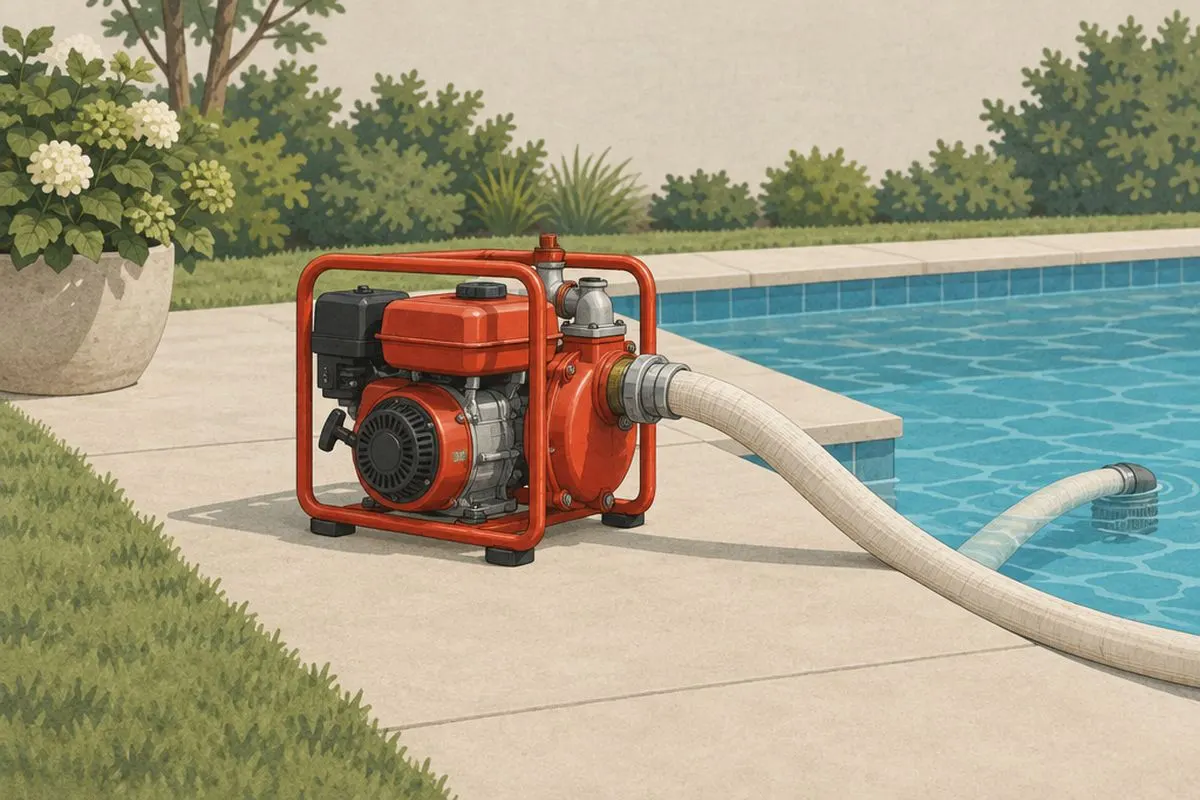
If you have a pool you already have 30,000–80,000 L and you need a pump and a strainer, not a tank. Pools are the most under-used wildfire water source in North America.
Versus a pond or creek
Free and effectively unlimited, if you have one and it does not run dry in August. Needs a foot valve and a drafting setup, and needs the lift to be under about 5 m.
Versus a cistern or buried tank
Buried tanks solve freezing and appearance and cost roughly double, plus excavation. Worth pricing if the tank would otherwise sit in the front yard.
Siting
Put it uphill of the pump if you possibly can — a flooded suction beats a lift every time. Keep it clear of the fuel, and remember a poly tank is itself combustible when empty.
01

Buying it

Effort Moderate

Where: Farm and ranch supply, water-systems dealers, plastics distributors. Genuinely a rural commodity.

Lead time: 1–6 weeks; large tanks are often a special order and freight is the constraint

Work out your required run time first and buy the capacity that gives you. Buying a tank because it was the one in the yard is how people end up with forty minutes of protection.

02

Installing it

Effort Hard

Time: A day for the pad, half a day to set and plumb the tank

You'll need: Excavation or a compacted gravel pad · Plumbing tools and fittings · Help — large tanks are unwieldy even empty

The pad is the job. A 2,500 gal tank weighs about 9,500 kg full, so the base has to be level, compacted and full-footprint. A tank on an uneven base will crack at the seam within a couple of years.

03

Living with it

Effort Easy

Keep it full through fire season — a tank at a third is a third of a defence. Drain or protect against freezing. Check fittings for weeps annually and clear debris from the fill screen.

If not this, then what

  • A swimming pool plus a strainer and foot valveVastly more water for a few hundred dollars, if you already have the pool.
  • A pond, creek or dugout with a drafting setupFree where available. Verify it still has water in a dry August, not in May.
  • Multiple IBC totesCAD $150–$400 each for 1,000 L. Cheap, ugly, and a legitimate way to build storage incrementally.
Our verdict

The least glamorous purchase here and, with the pump, the one that determines whether the rest of your water defence actually runs. Size it from run time and site it uphill of the pump.

We don't take payment for placement and we don't sell these products. If you think we've got something wrong here, tell us — we'll correct it.