Independent and reader-supported. Some links are affiliate links — see our disclosure. Codes vary by province, state and city: confirm with your local fire authority.
What commercial kitchens use

Wet Chemical Extinguisher (Class K / F)

Amerex / Buckeye Canada & United States $$ · Dearer than ABC, and correct for oil

A extinguisher charged with a potassium-salt solution that reacts with burning cooking oil to form a soapy crust, cooling it and sealing the surface. It is the class of extinguisher rated for deep fryers, and it does not scatter the fire the way dry chemical can.

Why we like it

  • Rated specifically for cooking oils and fats, which ABC powder is not
  • Fine mist rather than a blast — far less likely to spread burning oil
  • No powder over every surface in the kitchen

Watch out for

  • Two to three times the cost of an ABC unit
  • Not a general-purpose extinguisher — you still want ABC elsewhere in the house
Best for

Homes with a deep fryer, a wok setup, or anyone who cooks with large volumes of oil.
Read the full market guide — costs, install effort and alternatives ↓
Market guide

The whole commitment, end to end

What this actually is, what the market looks like, what it really costs, and how much of your time it wants — before you spend anything.

Buying it Easy
Installing it Trivial
Living with it Trivial
Up front

CAD $90-$400 depending on size.

Lead time

Days to two weeks

Time to install

10 minutes

How it works

Burning cooking oil sits well above its own auto-ignition temperature, which is why it relights the moment you take the flame away. Wet chemical agent is discharged as a fine mist that saponifies the surface of the oil — literally turning the top layer to soap — forming a blanket that seals vapour in and cools the fat below its ignition point. Dry chemical knocks the flame down but does not reliably stop the relight.

What the market looks like

A small market dominated by the commercial fire protection brands — Amerex, Buckeye, Ansul — because the demand comes from restaurants. Consumer availability is patchier than ABC and prices run CAD $150-$400 for a 2.5 gallon unit, with smaller 1.5 to 2 litre units aimed at homes appearing around CAD $90-$180. Classification differs by country: Class K in North America, Class F in Europe and the UK, same chemistry.

Features that actually matter

Class K rating
The specification that matters. An extinguisher without a K rating is not rated for cooking oil however good it is at other fires.
Fine mist discharge
Low-velocity application is deliberate. It is what stops the agent driving burning oil out of the container.
Wand applicator
Most units use a wand rather than a horn, for precise low-velocity application at the oil surface.
Rechargeable
These are serviceable units in the commercial mould, which is part of why they cost more.

What it really costs

Up front
CAD $90-$400 depending on size.
Consumables
None until used.
What else you'll need
A mounting bracket.
Over five years
Recharge after any use; professional inspection if your insurer asks for documentation.

Figures are typical street prices in Canadian and US dollars as of September 2026, gathered from public retail listings. They move with the season and with the exchange rate — treat them as a planning band, not a quote.

How it differs from the alternatives

Versus ABC dry chemical
ABC works on a small pan fire but is the wrong tool for volume oil: the discharge velocity can spread it and the relight risk remains. It also coats the entire kitchen in powder that gets into everything.
Versus a fire blanket
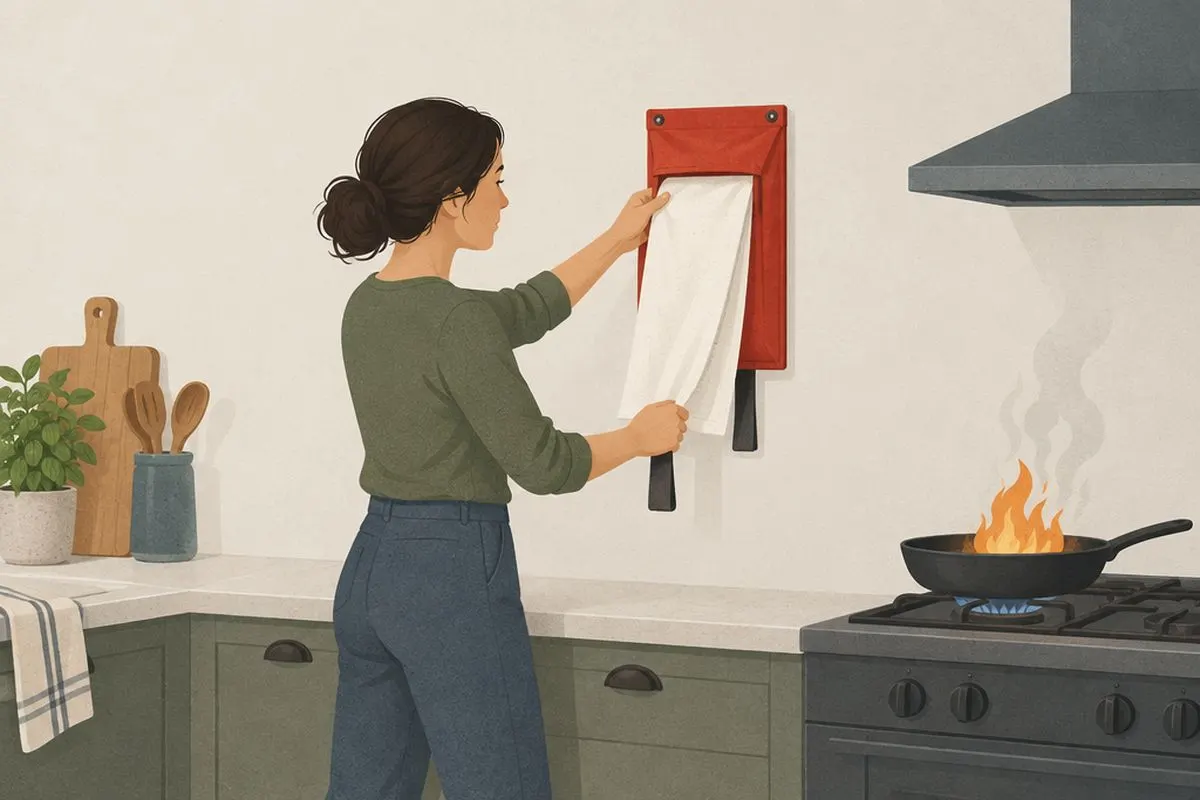
For a single pan, the blanket is simpler, cheaper and cleaner. The wet chemical unit earns its place with a deep fryer or a larger volume of oil the blanket cannot cover.
Honest scope
This is a specialist purchase. If you do not deep fry, a fire blanket plus a 10 lb ABC extinguisher by the exit covers the realistic domestic cases perfectly well.
01

Buying it

Effort Easy

Where: Fire protection suppliers, restaurant supply, Amazon.

Lead time: Days to two weeks

Check the label says Class K (or F). Some units marketed for kitchens are ordinary ABC in a smaller bottle.

02

Installing it

Effort Trivial

Time: 10 minutes

You'll need: Drill for the bracket

Mount on the exit side of the kitchen. Read the instructions once now — wet chemical is applied differently from dry chemical, starting at the far edge of the oil surface and sweeping toward you rather than blasting at the base of the flame.

03

Living with it

Effort Trivial

Check the gauge monthly. Service at the manufacturer's interval. Replace or recharge after any discharge.

If not this, then what

  • Fire blanketCheaper, simpler and the right answer for an ordinary pan fire.
  • 10 lb ABC extinguisherThe general-purpose unit every house should have anyway, by the exit.
Our verdict

Buy it if you deep fry. If you do not, a blanket and an ABC unit are the honest answer, and this is money better spent on alarms.

We don't take payment for placement and we don't sell these products. If you think we've got something wrong here, tell us — we'll correct it.